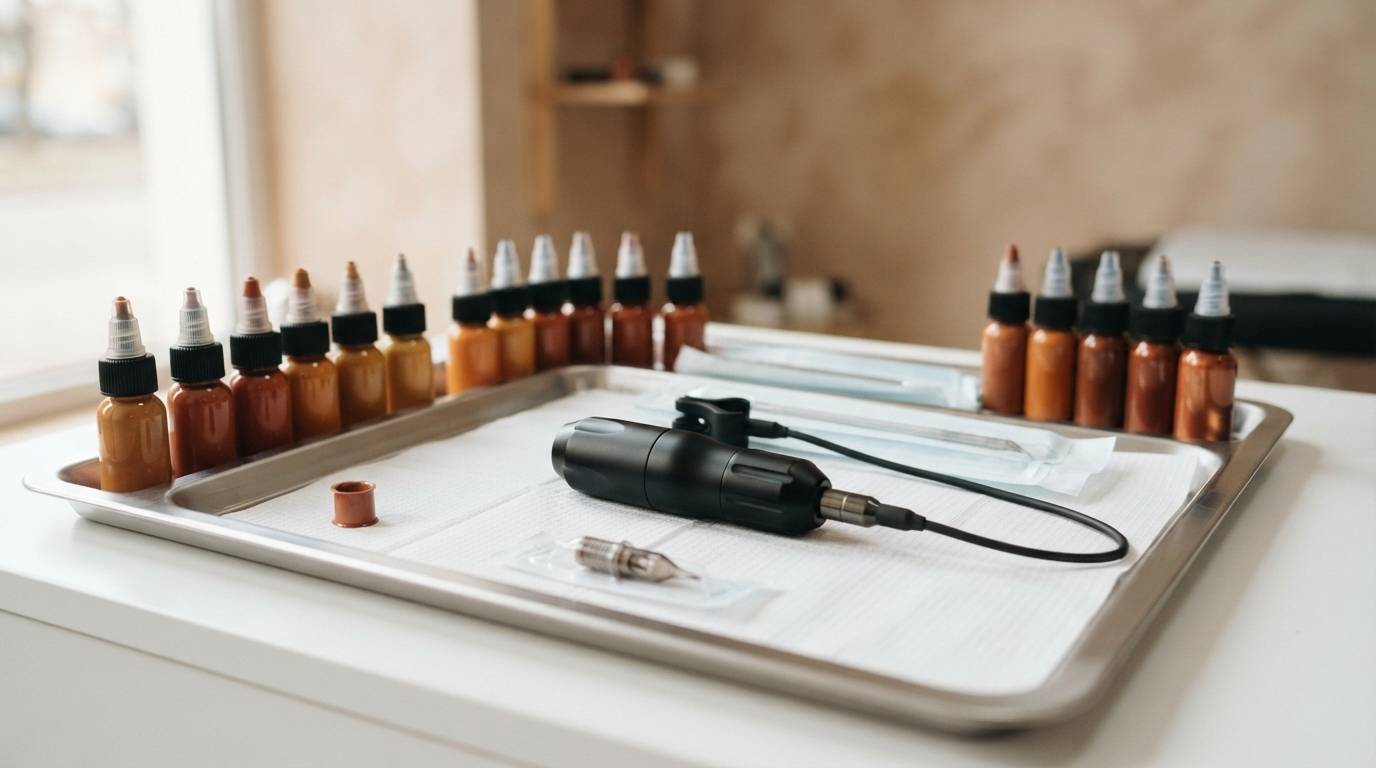
A tattoo studio doesn’t run on foot traffic alone. It runs on trust, portfolio, referrals, and the ability to turn interest into booked appointments, because the purchase is usually planned and the client compares style, hygiene, service, and price before deciding.
It’s also a business where operations matter from day one. The layout of the space, sterilization, material organization, consistency among artists, and the way you charge all shape how safe the studio feels and how often clients come back.
- by appointment
- visible portfolio
- hygiene and biosafety
- style-based service
What you need to understand before moving forward
Do your clients buy for style or convenience?
In tattooing, the decision often starts with the design and the artist, not proximity. You need to know whether your studio will attract clients through a specific style, a price range, location, or a broad lineup of artists, because that changes both your communication and how you build the team.
Will you run on your own schedule or with partner artists?
This defines your revenue model, how you use the space, and the pace of cash flow. A studio with partner tattoo artists needs clear rules for revenue share, scheduling, and service standards; a studio with an in-house team requires more control, higher fixed costs, and more management.
Does the space meet the sanitary requirements for the work?
It’s not enough for the place to look suitable. You need to check cleaning flow, prep areas, sharps disposal, material storage, and hygiene conditions that match the activity, because that affects licensing, operations, and client trust.
Does your service mix fit the structure you want to build?
Custom work, fine line, cover-ups, body piercing, and longer sessions all require different routines, different timing, and different levels of organization. The broader the mix, the higher the chance the operation becomes messy and the service loses consistency.
Can the surrounding demand support a studio with recurring appointments?
Not every busy neighborhood generates enough demand for tattooing. You need to see whether there’s an audience that matches your average ticket and booking frequency, and whether the studio will rely more on the local area or on social media and referrals.
The critical points of this business
Market
The key question is whether there’s an audience for the style you want to offer. In tattooing, demand isn’t generic: it varies by aesthetic, price range, artist reputation, and how easy it is to book.
Offer
You need to decide whether the studio will be generalist or specialized. That affects the type of client, the level of inventory, session length, and how you present the work.
Operations
The routine needs to fit appointment-based service, cleaning between sessions, and material organization. If operations fail, clients notice quickly and usually don’t return.
Regulation
The studio needs to operate within sanitary requirements and local rules for health-related and body-aesthetic services. Before opening, it’s worth checking what city hall and the health authority require for your type of space.
People
The quality of the business depends heavily on the portfolio and attitude of the tattoo artists. You need to evaluate who will tattoo, how the schedule will be divided, how to keep standards consistent, and how to avoid conflict between styles and expectations.
Financials
The investment doesn’t end when the space is set up. Initial cash needs to cover the period while the schedule is still building, the purchase of supplies, possible adjustments to the structure, and the months when occupancy is still unstable.
What can compromise the business
Opening without a clear position
A studio that tries to serve every kind of client usually loses strength in its communication and referrals. The risk is becoming just another generic space, with no strong reason for clients to choose you over another artist.
Underestimating sanitary requirements
If the setup isn’t ready for hygiene, disposal, and material organization, the business can run into operational and regulatory problems early on. Before signing a lease or buying equipment, confirm what the location needs to provide.
Relying on an unpredictable schedule
When the studio doesn’t have a steady flow of bookings, fixed costs weigh more than they should. This usually happens when promotion is weak, the portfolio isn’t clear, or the offer hasn’t been well defined.
Mixing services that require different routines
Adding too many services without proper structure tends to increase rework, delays, and pricing problems. If the space will offer tattooing, piercing, and other procedures, each one needs its own process.
What makes up the investment
Space adaptation
The size of the investment depends on the condition of the property, the need for renovations, the separation of areas, and the sanitary requirements of the city. A space already set up for service costs less to adapt than a property that needs to be completely reorganized.
Work equipment
Tables, chairs, lighting, support furniture, sterilization, and protective items form the base of the studio. Costs rise with the number of stations, the quality of the equipment, and the operating model with more or fewer artists.
Initial supply stock
Inks, needles, disposables, gloves, films, cleaning products, and prep materials need to match the expected volume of appointments. The greater the variety of styles and session types, the larger the stock requirement tends to be.
Licenses and compliance
Requirements vary by city, type of service, and how the studio will be classified. This item includes paperwork adjustments and possible upgrades needed to operate within local rules.
Initial communication
Portfolio, visual identity, photos of the space, and digital presence matter more here than in impulse-buy businesses. This investment grows as you need to build trust before the first full schedule.
Working capital
The amount needed depends on how long it takes for the schedule to gain momentum, the revenue-share model with artists, and how predictable the inflow is. In a tattoo studio, it’s common to go through an initial period where the business is already open, but occupancy is still not stable.
These components change from city to city and from project to project. In Vibz you build your business's investment with your own numbers. Calculate the investment in Vibz
Turn these questions into decisions
In a tattoo studio, the decision isn’t just about opening the door. It’s about defining the audience, the operating model, the space requirements, and the financial structure before committing to rent, renovation, and staff. That’s what you organize in Vibz.
Business Scope
It helps you turn the studio idea into a clear thesis: what style you’ll offer, for whom, with what proposition, and with which critical bets.
Market Intelligence
It helps you structure your reading of demand, customer profile, and local competition, so you can see whether the studio’s positioning makes sense.
Operational Plan
It helps you design the studio’s routine, from services and processes to layout, team, and service channels before you hire or buy.
Financial Modeling
It helps you turn those decisions into numbers, with investment, costs, revenue, working capital, and scenarios to test feasibility.
Before investing, you should know
- How many sessions per week do you need to sell to support the space?
- Which tattoo style will guide the studio’s offer?
- Will you work with partner artists, an in-house team, or a hybrid model?
- Does the property allow the sanitary setup the activity requires?
- How long can you operate before the schedule becomes predictable?
- How much of the demand will come from the surrounding area, and how much will come from referrals and digital presence?
Sua ideia merece mais do que um palpite. Estruture o negócio, teste suas premissas e entenda se ele faz sentido antes de comprometer tempo e dinheiro.
Planejar meu negócio no Vibz