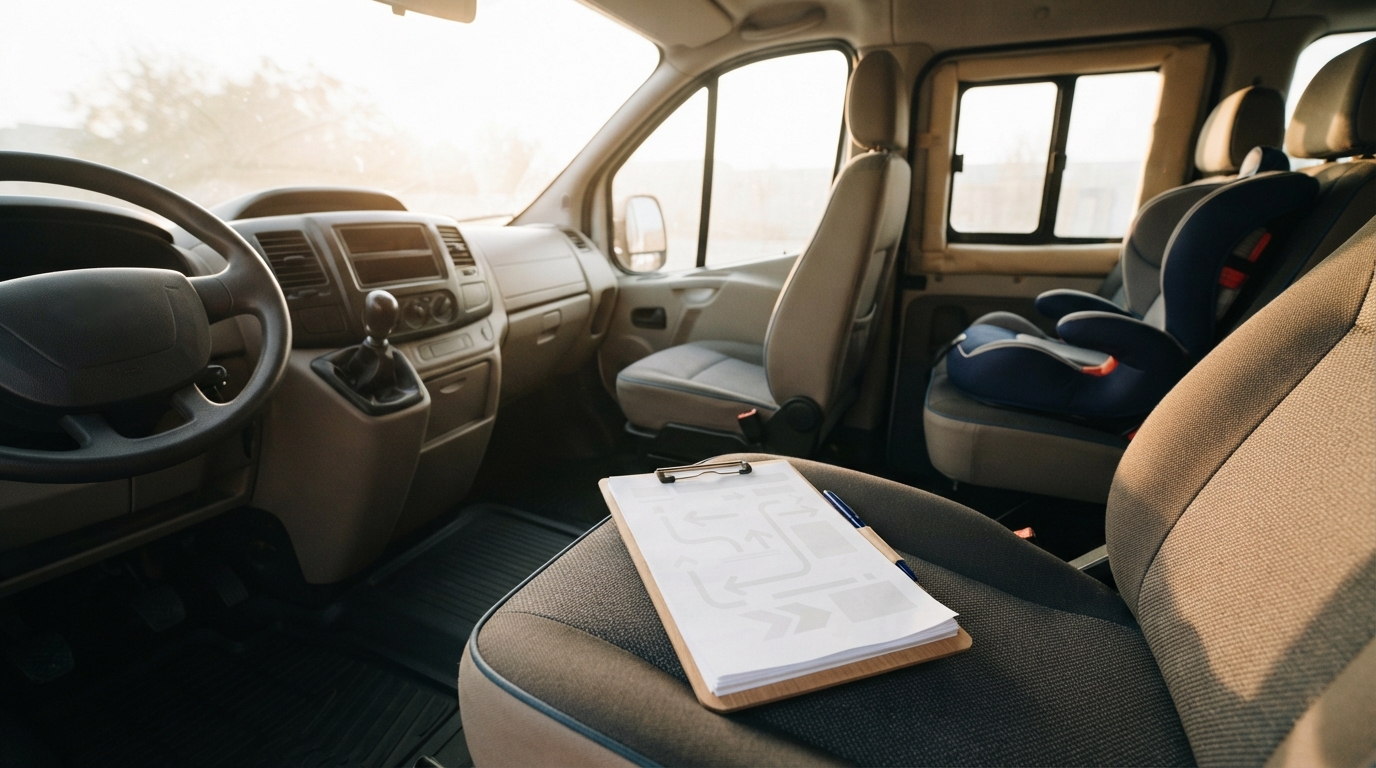
This kind of business works best when demand is recurring and schedules are predictable. Revenue usually depends on well-designed routes, the school calendar, and the trust of families, which makes market validation more important than how the fleet looks.
Before thinking about adding vehicles, it is worth understanding whether you can build a safe, compliant operation with enough occupancy on each route. In school transportation, planning mistakes show up quickly: a vehicle sitting idle, a poorly closed route, or a contract priced too low affects the business right away.
- recurring demand
- fixed routes
- operational safety
- monthly contracts
What you need to understand before moving forward
Is there enough demand on the route?
You need to map how many families actually need the service around the schools and neighborhoods you plan to serve. What matters here is not generic interest, but the combination of distance, schedule, convenience, and willingness to pay for reliability.
Do the chosen schools concentrate the right audience?
Not every school creates a useful base for school transportation. You should observe drop-off and pickup times, how spread out the students are geographically, and whether there is enough concentration of children who live beyond a walkable distance or outside the family’s usual driving route.
Will the operation be based on fixed routes or on-demand service?
The model changes everything: vehicle choice, travel time, occupancy, and revenue predictability. For school transportation, fixed routes usually give more control, while loose, on-demand service tends to complicate scheduling and reduce efficiency.
Can you meet local regulatory requirements?
Before investing, confirm which permits, inspections, insurance policies, and driver requirements apply in your city and state. In this business, documentation is not an administrative detail; it determines whether the operation can exist in a stable way.
What capacity does each vehicle actually need?
The decision is not to buy the largest vehicle available, but the one that best balances student count, distance traveled, and boarding time. If capacity is above demand, you carry cost without matching revenue; if it is below, you lose the contract or need an extra trip.
The critical points of this business
Market
You need to understand whether there is a concentration of families with recurring transportation needs during school hours. In this business, demand is not only about the number of children, but about the fit between location, family routine, and trust in the service.
Offer
The service needs to be clear: round trip, one shift only, by school, by neighborhood, or by age group. The more diffuse the service is, the harder it becomes to price it, organize routes, and maintain a consistent standard.
Operations
The routine involves punctuality, preventive maintenance, boarding and drop-off control, communication with guardians, and coverage for absences. You should validate whether you can operate without relying on improvisation, because delays and safety failures affect retention immediately.
Regulation
This is a central point. You need to check licenses, vehicle inspections, driver documentation, monitoring requirements, and local rules for student transportation, because operating outside the rules can make the business unviable before it even scales.
Financials
The numbers need to include vehicle cost, maintenance, fuel, insurance, staff, paperwork, and periods of low occupancy. What determines viability here is the relationship between recurring contracts and the fixed cost of the route, not just the margin per trip.
People
The driver and, when there is one, the attendant need to project safety and maintain discipline without conflict. In school transportation, how families perceive the service depends heavily on the behavior of the people in the vehicle, in addition to driving skill.
What can compromise the business
Building a route without a concentration of students
If the students are too spread out, the trip gets long, the operation loses efficiency, and the service becomes less attractive to families. Before closing the investment, check whether the route allows travel time that fits the school routine.
Buying a vehicle before securing a client base
A common mistake is starting with the fleet and only then trying to figure out who will fill the seats. Without contracts or a real intent to contract, the vehicle becomes a high fixed cost that is hard to offset.
Ignoring local compliance requirements
Transporting students requires attention to specific rules. If you do not confirm documentation, inspections, and operating requirements, you risk investing and later discovering that you cannot operate the way you planned.
Pricing without considering idle time
The price should cover not only the moving route, but also waiting time, empty return legs, maintenance, and periods when part of the capacity sits unused. When this is left out, revenue looks enough on paper and short in real operations.
Overrelying on seasonal demand
Some routes look good at first, but depend on a small number of families or on a very unstable calendar. You need to test whether demand holds throughout the school year and whether there is enough contract renewal to sustain the operation.
Turn these questions into decisions
Before investing, you need to turn the idea into route, capacity, requirements, and a complete financial picture. In school transportation, planning well is not a bureaucratic step; it is what separates a stable operation from an expensive vehicle sitting in the garage. Vibz helps organize these decisions based on what you learn about your market, your route, and your structure.
Business Scope
Use this stage to define the service model, the audience you will serve, the operating area, and the critical bets, such as route type, age group, and service proposition. It helps you make clear what will be validated before buying a vehicle or taking on contracts.
Market Intelligence
Here you structure the demand analysis by schools, neighborhoods, schedules, and family profiles, while also mapping competitors and entry barriers. This is what supports the decision about where to operate, whom to talk to, and which route makes sense to test first.
Operational Plan
This stage organizes the practical side of the service, including vehicles, boarding and drop-off processes, suppliers, staff, and contracting channels. It is the foundation for validating whether you can operate with safety, punctuality, and a predictable routine.
Financial Modeling
Use this stage to turn route, capacity, costs, and contracts into projections for investment, revenue, expenses, and cash flow. In school transportation, this calculation is decisive for knowing whether the expected occupancy can sustain the operation without straining cash.
Before investing, you should know
- How many children, by school and neighborhood, can you confirm as real demand for the route you want to build?
- What is the ideal vehicle capacity for the route you want to serve without too much spare room or the need for duplicate trips?
- What authorization, inspection, and documentation requirements apply to school transportation in your city?
- How many contracts or expressions of intent do you need to secure before taking on the cost of the first vehicle?
- How much does it cost to keep the operation running each month, including fuel, maintenance, insurance, staff, and paperwork?
- What is the plan if some students leave the route in the middle of the school year?
Sua ideia merece mais do que um palpite. Estruture o negócio, teste suas premissas e entenda se ele faz sentido antes de comprometer tempo e dinheiro.
Planejar meu negócio no Vibz