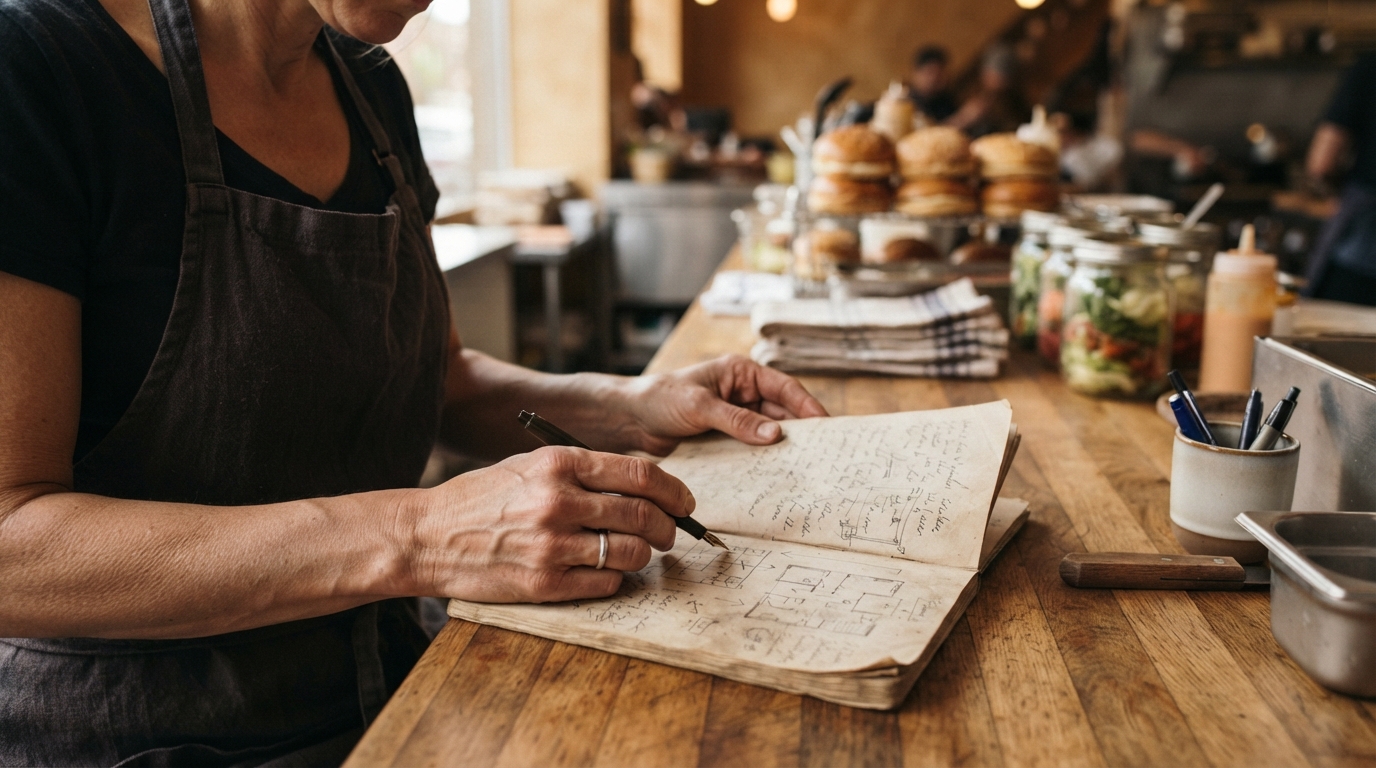
A food truck is not just a point of sale on wheels. It depends on a lean operation, a menu that can be prepared quickly, and a routine that works without the structure of a fixed dining room.
That changes the logic of the investment. Before buying or converting the vehicle, you need to understand where you’ll park, how you’ll restock supplies, what volume you need to sell at each stop, and which events, streets, or areas make sense for your model.
- mobile operation
- compact production
- sales by location
- lean menu
What you need to understand before moving forward
Where will the truck operate?
You need to decide whether you’ll rely on a fixed spot, events, rotating locations, or service in private areas. Each choice changes sales predictability, the moving routine, and the type of authorization you’ll need.
Does the menu fit a mobile operation?
Not every product works in a small space with short service times. The menu needs to be designed for quick preparation, low waste, and little variation from one service to the next.
Will you produce everything in the truck or from a support base?
That decision affects inventory, hygiene, service time, and the need for onboard equipment. In many cases, part of the prep has to happen outside the vehicle so the operation doesn’t get stuck.
How will you sell on slow days?
A food truck usually depends on concentrated demand at specific times and places. You need to know whether you’ll have reservations, events, partnerships, or other channels to reduce dependence on a single sales spot.
What authorizations does your model require?
The operation may involve municipal rules, health requirements, and permits for the location where the truck parks. This needs to be checked before investing, because the model changes depending on the city and the type of operation.
The critical points of this business
Market
You need to understand who buys in each location and at each time of day. The audience for a food truck changes a lot depending on the area, the type of event, and the moment, so the sales thesis has to be validated by context, not by instinct.
Offer
The menu needs to be short, repeatable, and compatible with the available space inside. What works here is what can be produced consistently, without requiring too much handling or long wait times.
Operations
The operation depends on flow inside the vehicle, ingredient organization, temperature control, and cleaning routines. If the truck layout doesn’t account for that from the start, service gets slow and quality varies too much.
Location
In a food truck, location is not a fixed address, it’s a stopping strategy. You need to validate where there is enough demand, permitted access, and a viable stay so you can sell without depending on occasional traffic.
Regulation
Requirements vary by city, type of food, and operating location. Before buying the vehicle, it’s worth mapping licenses, health rules, and restrictions on using public or private space.
Financials
The investment doesn’t end with the truck. You need to account for vehicle conversion, equipment, initial inventory, compliance, and the cash needed to get through the period before operations gain momentum.
What can compromise the business
A menu that doesn’t fit the available space
When the menu requires too many steps, service slows down and consistency drops. To avoid that, test the prep within a short counter-style workflow, with simple steps and little dependence on extra labor.
Dependence on a single sales spot
If the truck only works in one location, any change in permission, traffic, or event activity directly affects revenue. It’s better to validate more than one spot before concentrating the operation on a single bet.
Underestimating the restocking routine
Without an organized replenishment process, the truck loses sales because of missing ingredients or excess poorly planned inventory. You need to design purchasing, storage, and restocking based on the real operating frequency.
Buying the vehicle before validating the thesis
The most expensive mistake is usually investing heavily in the truck without testing the menu, the audience, and the location. First validate the sales logic; then size the structure that can support that operation.
Ignoring health and municipal requirements
If compliance is left for later, the business can stall before it even starts selling. The model needs to be built from the start in line with city rules and with the type of food you want to offer.
What makes up the investment
Vehicle conversion
The size of the investment depends on the truck’s condition, the level of internal modification, and the type of operation you want to build. The more complex the prep, the greater the need for counter space, refrigeration, power, and internal organization.
Kitchen equipment
Stove, griddle, fryer, refrigeration, and power support vary according to the menu. What you choose here needs to match the service pace and the space available inside the vehicle.
Licenses and compliance
The size of this block depends on the city, health requirements, and how you plan to operate on public roads or at private events. Before investing, you need to map everything required to start legally.
Initial inventory
Inventory starts with menu ingredients, packaging, and fast-replacement items. The amount varies according to operating frequency, product perishability, and the distance between the sales point and the support base.
Working capital
You need enough breathing room to cover purchases, travel, maintenance, and periods of irregular sales. The size of this capital depends on how many days the truck sits idle, how you buy ingredients, and how long it takes to stabilize the operation.
Support structure
In many models, the truck depends on a place for cleaning, storage, and additional prep. The cost varies depending on whether you use your own structure, a rented one, or a third-party one, and on the distance to sales locations.
These components change from city to city and from project to project. In Vibz you build your business's investment with your own numbers. Calculate the investment in Vibz
Turn these questions into decisions
In a food truck, the most common mistake is starting with the vehicle purchase and only later finding out whether the operation makes sense. When you structure the market, the offer, and the numbers before investing, the decision becomes clearer and less expensive. That’s what you organize in Vibz.
Business Scope
It helps you turn the food truck idea into a clear thesis: what will be sold, to whom, in which contexts, and with which critical bets. That gives shape to the questions that need to be validated before buying the vehicle.
Market Intelligence
It helps organize demand analysis, audience definition, and entry strategy by location and time of day. In a food truck, understanding where it makes sense to operate matters as much as defining the menu.
Operational Plan
It helps design the truck’s practical operation: menu, processes, suppliers, structure, and service routine. It’s the stage that shows whether the model fits the space and time you have.
Financial Modeling
It turns the earlier decisions into numbers for investment, costs, working capital, and feasibility scenario. For a food truck, that’s what separates an attractive idea from an operation that can actually hold itself up.
Before investing, you should know
- Which location or type of operation will account for most of the sales?
- How many menu items can you produce consistently inside the truck?
- Which equipment needs to be onboard and which can stay at the support base?
- Which licenses and permits do you need to operate in your city?
- How much initial inventory makes sense for your sales pace?
- What is the minimum cleaning, storage, and replenishment structure your operation requires?
- How many days of irregular sales do you need to withstand before the operation stabilizes?
Sua ideia merece mais do que um palpite. Estruture o negócio, teste suas premissas e entenda se ele faz sentido antes de comprometer tempo e dinheiro.
Planejar meu negócio no Vibz