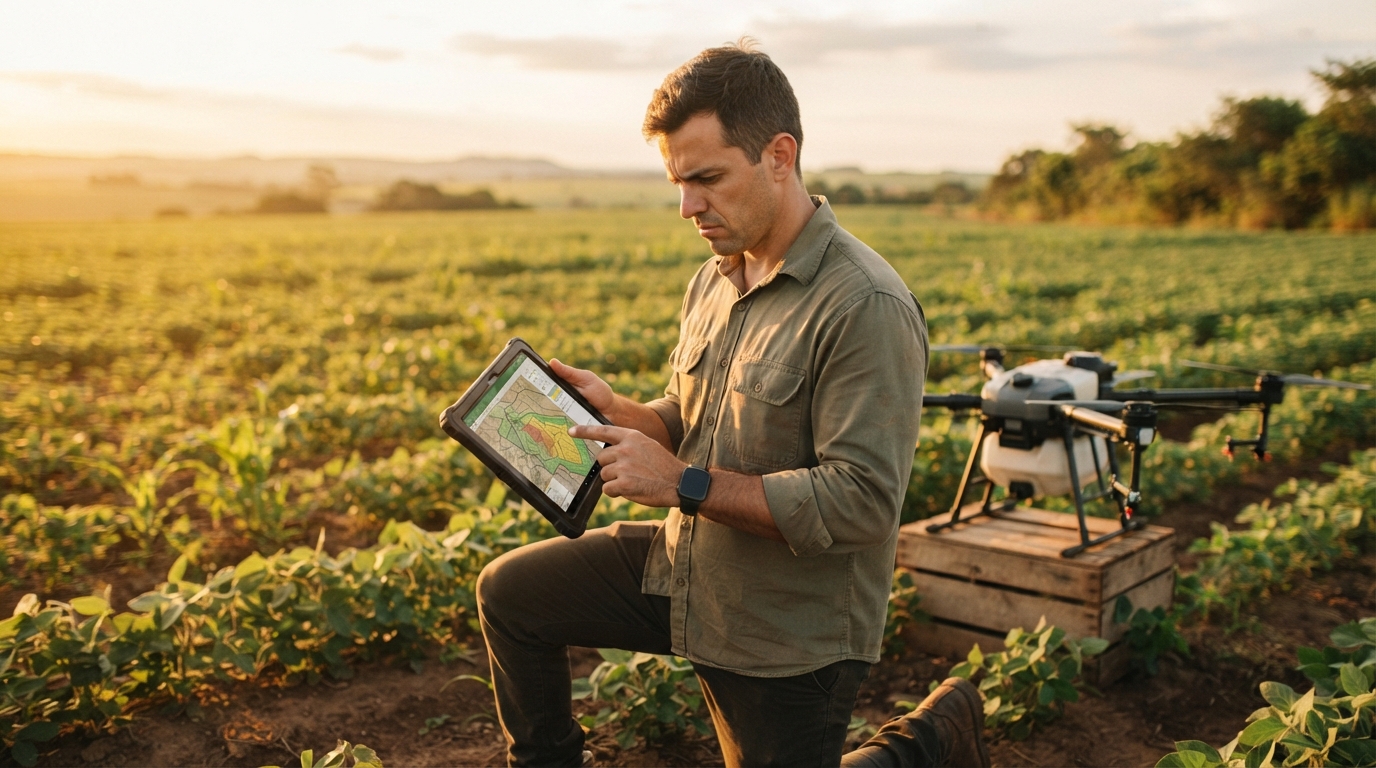
This is a technical service business, with field operations, travel, constant maintenance, and above-average operational risk. The difference is not just the drone, but your ability to serve crops, application windows, and quality standards that make sense for the producer.
Before buying equipment, you need to know whether you will work on your own properties, serve third parties, or combine both models. That changes the routine, the level of commercial demand, the need for staff, and how the operation is organized.
- technical service
- field operations
- constant maintenance
- application windows
What you need to understand before moving forward
Which crops will you serve?
The crop type defines flight height, application volume, service frequency, and the level of precision required. You need to know which crops exist in your region and which of them regularly accept this kind of application.
Is demand seasonal or ongoing?
This business follows the agricultural calendar. If demand is concentrated in just a few months, you need to plan for downtime, cash to get through the off-season, and alternative uses for the equipment.
Will you charge by area or by day?
The pricing model changes the entire commercial logic. Charging by area requires productivity control and a standardized service; charging by day works better when travel and complexity vary a lot from one property to another.
How much autonomy does the client expect?
Some producers only want execution; others expect support with scheduling, logistics, and defining the application window. You need to decide how far your delivery goes so you do not promise more than the operation can support.
Do you have safe access to the fields?
Not every property makes access, refilling, landing, movement, and ground support easy. It is worth mapping gates, internal roads, distance between plots, and support points before taking on any contract.
The critical points of this business
Market
You need to identify which producers actually buy this service and in what situations they switch from traditional spraying to drones. Interest exists when the operational gain is clear to the client, not just when the technology looks modern.
Operations
The routine includes mixing the spray solution, refilling, equipment checks, travel, and application records. The operation needs to be designed to work in the field, with a repeatable standard and room for controlled failures.
Regulation
This business depends on compliance with aerial operation rules, pesticide use, and technical responsibility requirements. Before investing, you need to confirm which requirements apply to the activity, the operator, and the application itself.
Financial
The investment does not end with the drone. Between equipment, batteries, maintenance, transport, training, insurance, compliance, and working capital, the entry cost and ongoing cost can change a lot depending on the scale you want to reach.
People
The operation requires someone who can fly, someone who understands application, and someone who handles ground logistics. In many cases, service quality depends more on a trained team than on the drone model itself.
Channels
You need to decide how you will reach the producer: direct sales, technical referrals, commercial partnerships, or recurring service for a fixed client base. Without a defined channel, the equipment stays idle outside the application windows.
What can compromise the business
Buying equipment before validating your client base
The most expensive mistake is starting with the drone and only later finding out who buys the service regularly. Without a minimum client base, the equipment becomes a fixed cost with no return, and maintenance adds up fast.
Ignoring crop seasonality
If you do not consider the region’s agricultural calendar, you may overestimate revenue and underestimate slow periods. That affects cash flow, team sizing, and the payback period.
Promising more coverage than the operation can handle
Taking on more area than the team can prepare and apply with quality leads to delays, rework, and lost trust. Before closing a contract, check how many hectares per day your operation can consistently deliver.
Treating compliance as a detail
In this business, a regulatory failure can interrupt contracts and damage your local reputation. It is better to validate operation, application, and technical responsibility requirements before the first sale.
Underestimating field logistics
Distance between properties, poor access, the need for ground support, and travel time all change real productivity. If you calculate only flight time, you will misjudge the operation’s capacity.
Turn these questions into decisions
Understanding who buys, when they buy, and how the operation holds up is what separates a technical idea from a viable business. In Vibz, you organize these decisions before investing and turn assumptions into a plan you can review calmly.
Business Scope
Use the Business Scope to define whether you will work with your own spraying operation, recurring service, or on-demand work, and to record audience, value proposition, and critical bets that need validation.
Market Intelligence
Market Intelligence helps you structure your reading of the region: crop types served, producer profile, local competition, and the most coherent entry strategy for the demand you can actually observe.
Operational Plan
The Operational Plan helps you design the real service routine, from mixing the spray solution to field travel, including team, suppliers, channels, and execution standards before the first purchase.
Financial Modeling
Financial Modeling turns these choices into investment, costs, expenses, working capital, and scenarios, so you know what you need to sell and how long you can sustain the operation.
Before investing, you should know
- Which crops in your region have recurring demand for drone spraying?
- How many properties can you already map as real potential clients?
- What will your daily application capacity be with the team and equipment you plan to use?
- How much does it cost to put the operation in the field, including equipment, transport, maintenance, and compliance?
- What interval between jobs do you need to cover fixed costs and keep cash on hand?
- Will you operate alone, with a pilot and ground support, or with a structured team from the start?
- Which legal and technical requirements apply to the kind of application you want to offer?
Sua ideia merece mais do que um palpite. Estruture o negócio, teste suas premissas e entenda se ele faz sentido antes de comprometer tempo e dinheiro.
Planejar meu negócio no Vibz