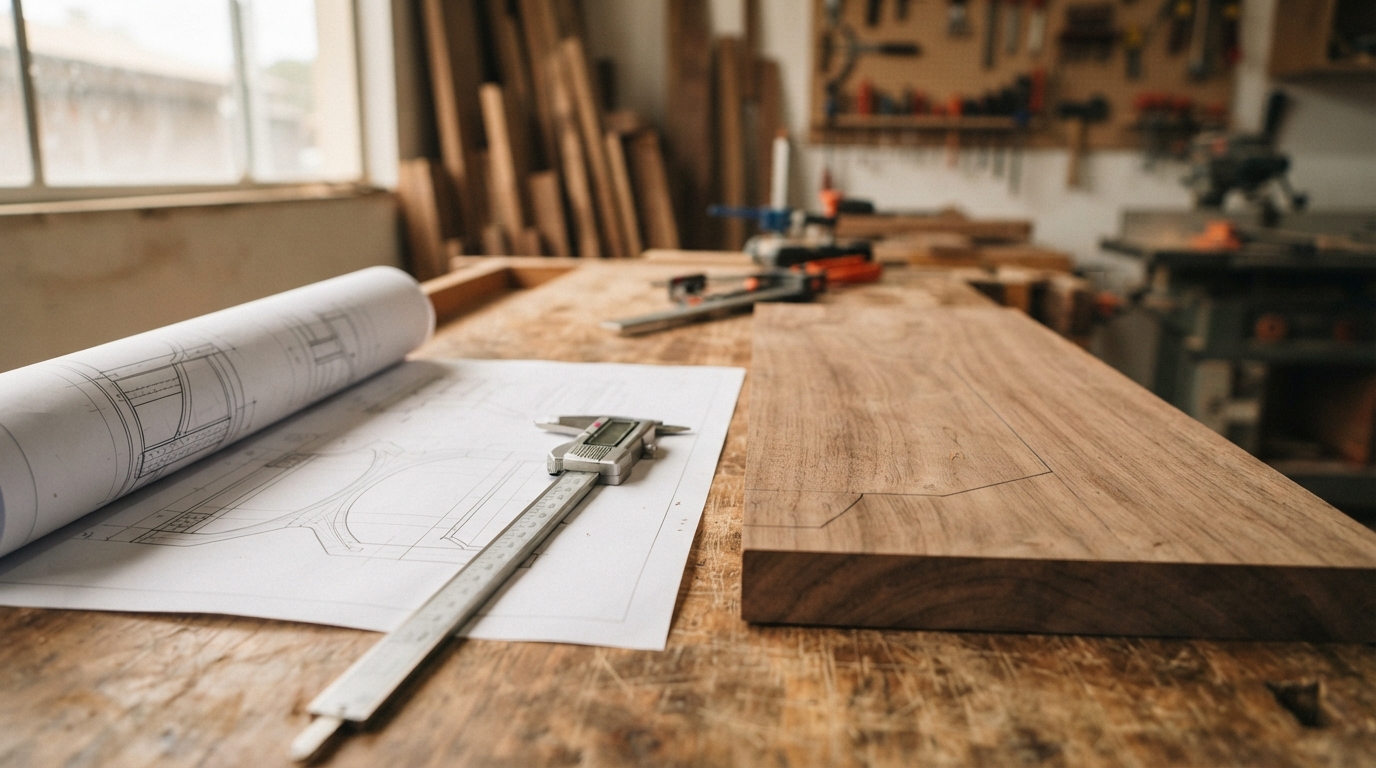
A custom furniture factory does not live on standardized volume. It depends on accurate measurements, a well-defined design, production with a clear sequence, and installation without improvisation, because every mistake shows up in the furniture, the deadline, and the final cost.
Before investing, you need to understand whether you will serve residential renovations, new apartments, offices, or retail stores. Each of these markets changes the type of design, installation complexity, buying profile, and the risk of rework.
- made-to-order production
- technical installation
- custom design
- negotiated deadline
What you need to understand before moving forward
What kind of customer will you serve?
Residential, corporate, and commercial clients require different processes. You need to choose where you have the most capacity to sell, measure, and install consistently, because mixing profiles at the start usually increases design errors and operational difficulty.
Will you only produce furniture or also install it?
That decision changes the company structure. When installation is part of the package, you need to plan for staff, logistics, responsibility for on-site adjustments, and time for technical visits, because many problems only appear on location.
Does your process start with technical measurement or with a finalized design?
If measurement comes too late or is done poorly, the risk of remaking parts grows. In this business, the right flow between site visit, drawing, approval, and production is part of the product, not just an administrative step.
Do you work with one-off orders or repeatable lines?
The more customized the order, the harder it becomes to standardize cutting, assembly, and pricing. It is worth deciding how far customization makes sense, because that defines productivity, lead time, and the need for skilled labor.
Which materials and hardware can you source reliably?
The real offer depends on what you can replenish without delays and without changing standards midway through a project. If the company promises a finish or opening system it cannot consistently support, delivery becomes unstable.
The critical points of this business
Market
You need to understand whether demand comes from end customers, architects, contractors, or retailers. Each channel changes the sales cycle, average order size, and level of technical demand.
Offer
Your offer needs to make clear what is included: only manufacturing, manufacturing with installation, technical design, disassembly, support, and adjustments. If that is not defined, the quote becomes fragile and margin disappears in rework.
Operations
Operations need to work with a cutting, edging, drilling, assembly, and shipping flow that matches the type of furniture sold. The bottleneck is usually not making the piece, but organizing many different pieces without losing sequence.
Financials
In this business, you need to separate material cost, direct labor, cutting waste, rework, freight, and installation. Since payment often follows project stages, working capital needs to be calculated carefully.
People
Quality depends on reading the design, executing with precision, and solving on-site adjustments. A technically weak team may still produce, but it tends to create hidden costs through corrections and delays.
Technology
You need to decide whether you will use technical drawing, production control, and order management in an integrated way. Without that, the company grows in orders, but not in predictability.
What can compromise the business
Quoting without a closed scope
When the client asks for changes during the process and the company does not record what is included, the extra work turns into a loss. To avoid that, the quote needs to separate measurements, materials, hardware, installation, and adjustments.
Measurement done without a standard
A wrong measurement compromises the part, the deadline, and the company’s reputation. Before selling, it is worth defining who measures, how it is checked, and when approval enters the flow.
A mix that is bigger than the operation can handle
Accepting kitchens, closets, panels, offices, and retail projects at the same time can look like opportunity, but it usually disrupts production and purchasing. The risk is losing efficiency exactly where the business should gain repetition.
Dependence on improvised installation
If on-site assembly is not planned with a method, final delivery becomes a source of cost and conflict. You need to know what kind of job site you accept and what minimum conditions you need in order to install.
Buying raw materials without predictability
Changing board, hardware, or finish midway through an order alters standards and increases rework. The business needs to check whether it can maintain stable specifications with suppliers and lead times compatible with the order pipeline.
Turn these questions into decisions
In this kind of business, the plan is not there to decorate the idea. It needs to show whether you can sell with a clear scope, produce in sequence, and install without losing control of deadline and cost. That is what organizes the decision before the first investment.
Business Scope
Use this step to turn the factory idea into a testable thesis: what kind of furniture you will make, for whom, with what level of customization, and which assumptions need to be confirmed before buying structure.
Operational Plan
Here you map the real workflow, from measurement to installation, including processes, suppliers, team, and channels. This helps you check whether the operation can handle the kind of order you want to sell.
Financial Modeling
This step turns your decisions into numbers and shows how much capital you need to get started, what cost each project carries, and how cash flow behaves when payments do not move at the same pace as production.
Market Intelligence
Use this step to organize your view of the market, compare customer profiles, and define your entry strategy. It helps you decide whether it makes more sense to start with residential, corporate, or another channel with a more predictable rhythm.
Before investing, you should know
- How many projects per month do you need to close to support the structure you plan to build?
- What will be your standard scope: only manufacturing, manufacturing with installation, or also technical design?
- Who does the measurement, when does it happen, and how do you validate that data before production?
- Which materials, boards, hardware, and finishes can you source reliably without changing standards midway through an order?
- How long does it actually take from approved quote to completed production and final installation?
- What kind of customer will you prioritize at the beginning to reduce complexity and build operational repetition?
Sua ideia merece mais do que um palpite. Estruture o negócio, teste suas premissas e entenda se ele faz sentido antes de comprometer tempo e dinheiro.
Planejar meu negócio no Vibz