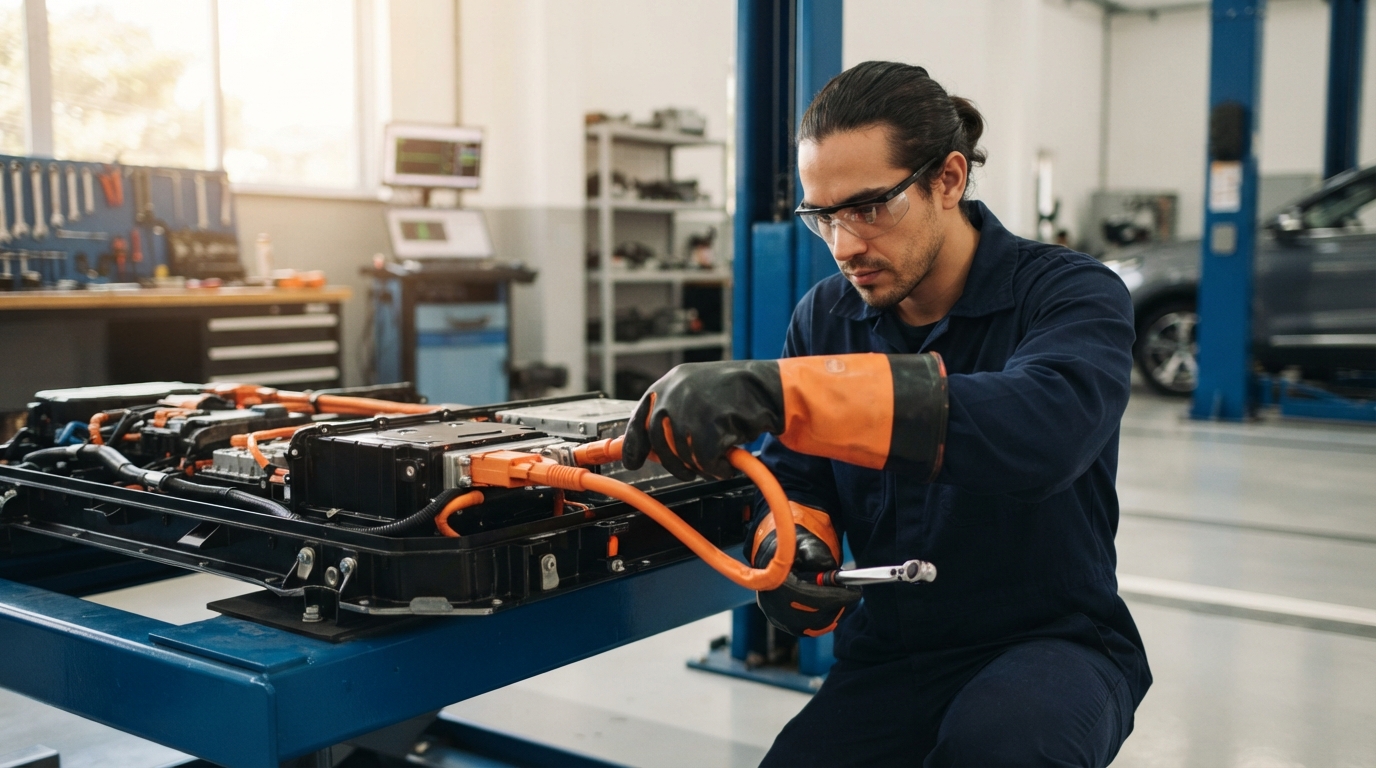
This business doesn’t start with the number of cars that drive past the door. It starts with your ability to handle failures that require precise diagnosis, safe procedures, and a team trained to work on systems that leave no room for improvisation.
It also changes the logic of the workshop: not every job will be mechanical, and not every dollar will come from heavy maintenance. In many cases, the difference lies in diagnostics, auxiliary system checks, preventive maintenance, and service for fleets or owners who already know they can’t take the car anywhere.
- high voltage
- technical diagnostics
- preventive maintenance
- specialized equipment
What you need to understand before moving forward
Which services will you take on?
You need to decide whether the workshop will focus on diagnostics, preventive maintenance, auxiliary system repairs, batteries, cooling systems, regenerative braking, or a broader service offering. That choice changes the structure, the tools you need, and the type of customer that makes sense to target.
Do you really have the ability to work safely?
Electric and hybrid cars require a clear procedure for de-energizing, isolating, identifying risk, and recording what was done. If that is not defined yet, the business should not move forward as a specialized workshop, because the failure here is not just operational. It is about safety and responsibility.
What kind of customer do you want to serve?
You need to know whether you’ll serve end customers, fleets, shops that outsource diagnostics, or insurers and roadside assistance providers. Each profile changes turnaround time, ticket size, repeat business, and the level of technical documentation required.
Can your team diagnose before taking things apart?
In this kind of workshop, disassembling by trial and error usually makes the service more expensive and raises the risk of mistakes. What matters is whether you have the knowledge, compatible scanner, fault reading capability, and a method to confirm the cause before opening the car.
Which services depend on parts, and which depend on knowledge?
In many cases, the bottleneck is not just the part itself, but the ability to identify the correct component and decide whether it makes sense to repair or replace it. That affects lead time, inventory purchases, and margin, because a poorly positioned workshop ends up as a storage room for unused parts.
Can you operate with low volume at the beginning?
This is a business where trust can build slowly, because customers want proof of competence before handing over the car. You need to know the minimum number of work orders that keeps the operation running while your reputation is still being built.
The critical points of this business
Market
It is worth understanding whether there is a concentration of electric and hybrid vehicles within your service area and what problems those customers already face with regular workshops. It also matters to identify whether there is a shortage of specialized labor in the region, because that can create room to grow, but it can also limit how fast you scale.
Offer
The workshop needs to define with precision what it delivers: diagnostics, preventive maintenance, component repair, high-voltage system checks, or fleet support. The clearer the scope, the easier it is to price work, train the team, and avoid jobs that are outside your capacity.
Operations
The day-to-day routine requires safety procedures, proper tools, space organization, and vehicle intake and release processes. It is important to confirm whether the workshop can isolate areas, record interventions, and prevent a simple mistake from compromising the vehicle or the team.
Financials
The investment is not just in the physical setup. You need to model tools, training, space adaptation, working capital, and payment terms, because the service may require more technical time than a regular workshop, and that affects cash flow.
Technology
This business depends on electronic diagnostics, code reading, updated knowledge, and compatibility across different platforms. Without that, the workshop is limited to very basic tasks and loses the very kind of work that justifies the specialization.
Regulation
The operation needs to comply with safety, disposal, and component handling rules, as well as local requirements for automotive activity. If you do not map this out beforehand, you may build a technically solid structure and still run into trouble operating with peace of mind.
What can compromise the business
Starting with too broad a scope
Trying to service any electric or hybrid car from day one usually creates rework and weakens trust. The better path is to start with the services you already master and expand once the process is stable.
Buying equipment before defining demand
Expensive tools without a clear service line become idle cost. Before investing, you need to know which models and which types of maintenance will actually come through the workshop.
Treating diagnostics as a secondary service
In this business, good diagnostics are central to the offer. If they are seen only as a quick step before swapping parts, margins shrink and technical errors become more likely.
Ignoring ongoing training
Technology changes, and systems vary across brands and vehicle generations. If the team does not keep up with procedures and technical reading, the workshop loses accuracy and starts turning away jobs it could handle well.
Not separating high and low complexity services
Mixing everything into the same routine increases operational risk and makes pricing harder. It is worth defining which services belong on a technical bench and which can follow a simpler flow, with clear responsibility controls.
Turn these questions into decisions
Before investing, you need to turn the idea into a workshop thesis: which cars you will serve, which services you will perform, what structure you need, and how much it costs to operate safely. Vibz helps organize these decisions in stages, so you can move beyond intuition and see the business more clearly.
Business Scope
Helps define the workshop scope: which problems you solve, for which vehicles, with what value proposition, and which assumptions need to be validated before opening the doors.
Market Intelligence
Organizes the analysis of the local market and customer profile, so you can compare demand, competition, vehicle types served, and entry strategy without making decisions in the dark.
Operational Plan
Structures the workshop operation, including services, processes, suppliers, team, and customer channels, so you can validate whether the model works in practice.
Financial Modeling
Turns technical choices into numbers, helping you estimate investment, costs, working capital, and viability scenarios before committing capital.
Before investing, you should know
- Which electric and hybrid car models do you want to serve first?
- Which services can you perform safely from the start?
- Which equipment and tools are actually necessary for your scope?
- How much do you need to invest in physical setup and training?
- What will be your initial source of customers: end customers, fleets, or partners?
- How long does each type of service actually take?
- What minimum monthly revenue keeps the operation running until the workshop builds a reputation?
Sua ideia merece mais do que um palpite. Estruture o negócio, teste suas premissas e entenda se ele faz sentido antes de comprometer tempo e dinheiro.
Planejar meu negócio no Vibz