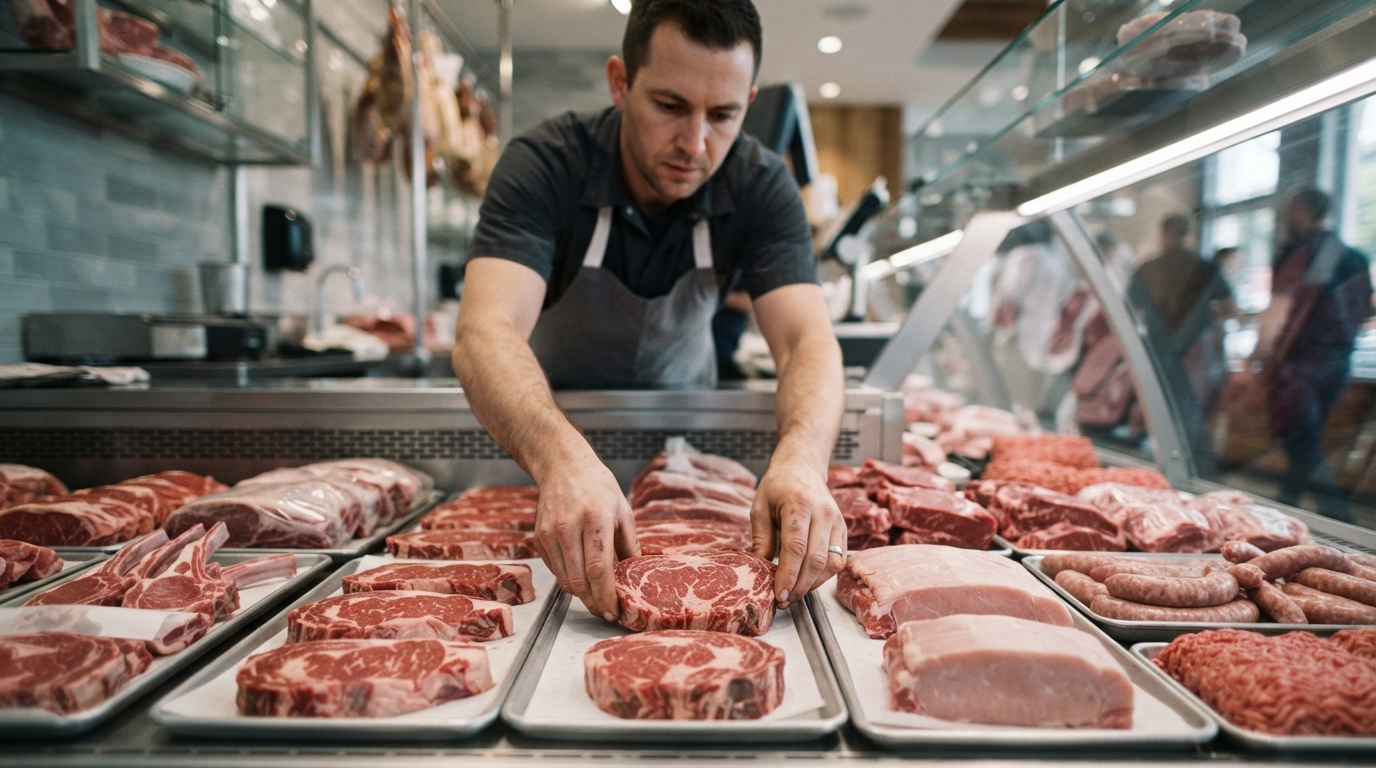
A butcher shop depends on turnover, control of perishables, and well-calibrated purchasing. What looks like a simple operation, in practice, requires decisions about meat sourcing, cutting standards, display, preservation, and replenishment frequency.
If you want to open this business, you need to treat planning as part of the opening, not something you deal with after the build-out. The neighborhood, the customer buying profile, and the supply model all change the shape of the operation quite a bit.
- perishables
- cutting and deboning
- cold chain
- repeat purchasing
What you need to understand before moving forward
What will your supply model be?
You need to decide whether you will buy meat ready for sale, do your own deboning, or combine both. That choice changes the setup, the routine, the sanitary controls, and the need for technically skilled staff.
Which cuts will make up the initial offer?
Not every butcher shop needs to start with a broad mix. The ideal is to define the cuts that make sense for the local customer base and for your replenishment capacity, because too much variety increases waste and complexity.
How often will you restock?
Meat requires fast turnover and strict preservation control. Before opening, you need to understand how many times a week you will buy, how you will store it, and what happens to product that does not move within the expected time.
What buying profile exists in the area?
You need to observe whether the neighborhood buys for daily use, weekly use, or specific occasions. That changes stock size, the weight of promotions, the most sought-after cuts, and even the need for portioning.
Will you have a counter, self-service, or a mixed model?
The service format defines flow, staffing, and product display. In a butcher shop, the way you sell directly affects shrink, service speed, and hygiene control.
Which sanitary requirements does the property meet?
Before making any decision, confirm whether the space can handle proper prep, refrigeration, cleaning, and waste disposal areas. In a butcher shop, physical suitability is not a detail: it shapes the operation from day one.
The critical points of this business
Market
You need to understand whether local demand supports frequent purchases of fresh meat and which cuts actually sell in the area. That matters more than opening with a wide offer without knowing what the neighborhood really consumes.
Offer
The offer needs to balance fast-moving cuts, higher-margin items, and products that help build the basket. In a butcher shop, the wrong mix ties up capital in inventory and increases losses from expiry or devaluation.
Operations
The routine involves receiving, checking, deboning, portioning, display, and cleaning. If any step is improvised, quality drops and shrink rises, even with good demand.
Regulation
Licenses, sanitary requirements, waste handling, and structural compliance need to be checked before opening. In a butcher shop, the regulatory side is not secondary; it affects the property, the equipment, and the daily routine.
Financial
The investment does not end with the build-out and the equipment. You need to project inventory, replenishment, losses, payroll, and working capital to get through the first months without relying on disorganized purchasing.
People
The quality of service and cutting depends on people who know how to handle meat with consistent standards. If the team lacks technique and discipline, the customer experience and the margin suffer at the same time.
What can compromise the business
Too broad a mix for real demand
Opening with too many cuts and too few sales per item increases leftovers and makes replenishment harder. To avoid that, start with an offer that fits the neighborhood’s buying profile and adjust based on turnover.
Structure not suited for meat handling
A property that seems sufficient can fall short on cold storage, sanitation, and workflow. That compromises both operations and compliance, so the check needs to happen before you sign anything.
Purchasing without loss control
In a butcher shop, loss from cutting, demand swings, and poor storage hits results quickly. If you do not define a standard for checking and replenishing, inventory becomes a constant leak.
Staff without cutting and service skills
Uneven cuts, slow service, and weak guidance on preparation reduce trust and increase waste. It is worth confirming whether you will have someone with hands-on mastery from the start or whether you will need to train the team.
Relying on low prices to win customers
Winning customers on price alone usually squeezes margins in a business that already has sensitive operating costs. The safer path is to understand what brings people back: freshness, consistency, trust, and convenience.
What makes up the investment
Property suitability
The size depends on the need for prep space, refrigeration, circulation, and cleaning. The condition of the location also matters, as does how much it already fits the requirements of the type of operation you want to open.
Cold equipment
Cold rooms, display cases, freezers, and preservation systems depend on meat volume, replenishment frequency, and display standards. The larger the operation and the broader the mix, the greater the refrigeration requirement.
Cutting and sanitation tools
Knives, saws, cutting boards, PPE, containers, and cleaning supplies vary according to the level of deboning, portioning, and in-house production. If you will do more processing on site, this category grows.
Initial inventory
The initial purchase volume depends on the cuts chosen, expected turnover, and opening strategy. A butcher shop focused on variety needs more capital tied up in goods than a leaner model.
Licenses and compliance
The need for documentation and sanitary adjustments varies according to the municipality, the property, and the operating model. This item needs to be checked early, because it may require physical changes before opening.
Working capital
The size of this component depends on how long it takes sales to stabilize, the purchasing frequency, and the acceptable level of early losses. In a perishables business, opening without cash cushion often forces bad inventory decisions.
These components change from city to city and from project to project. In Vibz you build your business's investment with your own numbers. Calculate the investment in Vibz
Turn these questions into decisions
Before investing, you need to turn assumptions about demand, mix, operations, and cost into a clear plan. That is what keeps you from opening a butcher shop based only on street traffic; with Vibz, you organize those decisions before committing capital.
Business Scope
It helps you define the butcher shop model, the audience you want to serve, and the critical business bets, such as supply model, initial mix, and value proposition.
Market Intelligence
It helps structure the analysis of the area, the buying profile, and local competition, making it clearer what kind of demand makes sense for your butcher shop.
Operational Plan
It helps you design the store’s practical routine, from receiving and preservation to cutting, display, service, and cleaning, before you buy or hire.
Financial Modeling
It turns those decisions into numbers, so you can project investment, costs, working capital, and cash flow before opening the doors.
Before investing, you should know
- How many kilos per day does your location need to sell to sustain the operation?
- Which cut mix makes sense for the neighborhood’s buying profile?
- Will you buy meat ready for sale, do deboning on site, or combine both?
- How long can the meat stay in stock without hurting turnover and quality?
- Does the property allow for cold storage, handling, and cleaning within sanitary requirements?
- How many people do you need to keep service, cutting, and replenishment running without improvisation?
- How much capital do you need to reserve for inventory, early losses, and replenishment until sales stabilize?
Sua ideia merece mais do que um palpite. Estruture o negócio, teste suas premissas e entenda se ele faz sentido antes de comprometer tempo e dinheiro.
Planejar meu negócio no Vibz