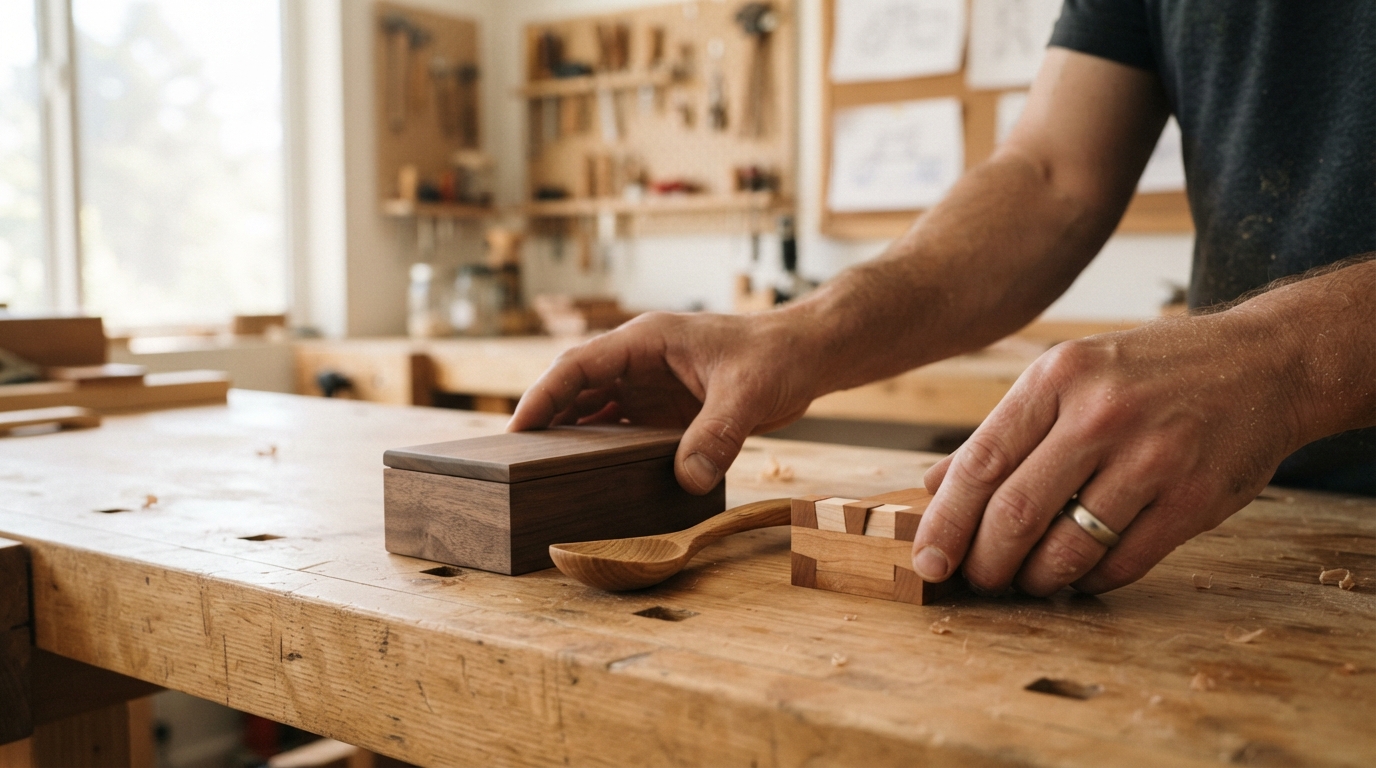
An artisan woodworking shop usually starts small, with made-to-order production and decisions closely tied to the space you have, the machines you can install, and the kind of client willing to wait for more careful work. That changes the business logic: every project has to fit your production capacity, your cash flow, and your finish standards.
Before buying equipment or renting a workshop, it is worth understanding whether you want to compete on customization, finish quality, or speed. In woodworking, these three points rarely solve themselves, and the way you combine them defines what you can sell consistently.
- made to order
- hand-finished
- custom production
- production cycle
What you need to understand before moving forward
Will you make custom pieces or a product line?
This is the first split. Custom work increases the need for briefings, measurements, approvals, and fine adjustments; your own line requires standardization and repetition. The choice changes your customer profile, the time each order takes, and how much your operation depends on rework.
Which pieces can you produce repeatedly?
Not every handcrafted piece needs to be completely unique. Identify which products allow you to reuse dimensions, hardware, processes, and jigs, because that reduces errors and improves delivery predictability. Without that definition, the shop becomes a chain of different projects that are hard to price and organize.
What level of finish does your customer expect?
The finish standard defines production time, wood selection, sanding needs, paint, varnish, and final adjustments. If you promise a level of finish your team and equipment cannot support, the problem shows up in deadlines, costs, and reputation.
Does your space handle cutting, assembly, and storage?
A woodworking shop is not just a bench and a machine. You need separate areas for cutting, assembly, curing, sheet stock, finished parts, and supplies, because poor organization leads to material loss and delays. The space also needs to allow pieces to move in and out without damage.
Will you buy wood, sheet goods, and hardware as needed or keep stock?
This affects tied-up capital, delivery time, and the risk of leftover material. Buying as needed reduces inventory, but it can slow production when a basic item is missing; keeping stock improves speed, but it requires control so it does not hurt cash flow.
Who measures, approves, and installs?
In many jobs, the mistake is not in the making but in the measuring and installation. If those steps are yours, you need clear responsibility, scheduling, and a standard check process. If they belong to third parties, you need a way to avoid gaps between what was sold and what will be delivered.
The critical points of this business
Market
You need to know whether you will serve end customers, architects, stores, or companies. Each channel calls for different volume, sales language, lead time, and delivery standards, and that changes how you sell and produce.
Offer
Your offer needs to be clear: fitted furniture, signature pieces, restoration, woodworking for construction projects, or decorative items. The broader the promise, the harder it gets to keep finish standards and pricing consistent.
Operations
Operations depend on a well-defined sequence between measurement, design, cutting, assembly, finishing, and installation. If one step is not standardized, rework grows and the schedule becomes less predictable.
Financials
What matters here is not just the sale itself, but the deposit, supplier payment terms, and the time between buying materials and getting paid in full. You need to model working capital based on the real cycle of each order type.
Location
The location matters less for foot traffic and more for logistics. Access for loading, unloading, noise, ventilation, and storage space matter more than the outside appearance.
People
Quality depends heavily on the skill of the people who cut, assemble, and finish. You need to know which tasks require experienced labor and which can be trained without compromising the piece’s standard.
What can compromise the business
Selling more variety than the workshop can handle
When the shop accepts any order, material inventory, design adjustments, and production time become hard to control. The result is usually delays and tight margins. Before expanding the mix, check whether you already have a small set of pieces with a repeatable process.
Pricing without accounting for rework and installation
In artisan woodworking, the price does not end with the finished piece. Measurement, fine adjustments, transport, and installation can take more time than the making itself. If those costs are left out, the order looks good until you add up the real hours.
Buying machines before defining the production model
Equipment bought on impulse can take up space, tie up capital, and fail to solve the main bottleneck. Sometimes the problem is the workflow, not the lack of a machine. First define the type of piece and the expected volume; then choose what truly makes a difference.
Depending on wood and hardware without lead-time control
A delay in supplies stops production and puts delivery at risk. In woodworking, one missing item can hold up an entire project. That is why it helps to map which materials are critical and which ones have the most sensitive lead times.
Accepting projects without validating measurements and scope
A large share of conflicts comes from incomplete drawings, wrong measurements, or poorly aligned expectations. If you do not record what was approved, the chance of having to redo work goes up. The rule here is simple: clear scope before cutting the first piece.
Turn these questions into decisions
Understanding your market and turning that into a plan is what separates a viable woodworking shop from one that spends its days putting out fires. In Vibz, you organize those decisions before buying machines, hiring people, or signing a long lease.
Business Scope
It helps you define whether the shop will work on custom orders, its own product line, or complementary services, while also making clear which problem it solves, who it sells to, and which bets need to be validated before you invest.
Market Intelligence
It is used to structure your analysis of the audience, channels, and competition you need to watch before opening. This helps you decide whether it makes more sense to serve end customers, design professionals, or companies, and to understand how to enter without promising what the operation cannot support.
Operational Plan
It organizes the layout of the workshop, processes, suppliers, team, and delivery channels. For artisan woodworking, this helps you see where measurement fits, how finishing will be done, and which steps need routines to avoid rework.
Financial Modeling
It turns your choices into numbers for investment, costs, working capital, and cash flow. Here you test whether the model still works when materials are bought upfront and payment comes later, which is one of the most common pressures in this kind of business.
Before investing, you should know
- How many orders per month do you need to cover rent, staff, and supplies without relying on a single large project?
- What is the average time between taking the order, buying materials, producing, and installing?
- How much of the value will be collected upfront, and how much will be left for final delivery?
- Which machines are truly necessary for the type of pieces you want to sell?
- How much space do you need for stock, cutting, assembly, and finished pieces?
- Who will handle measurement, design, fabrication, and installation at each stage?
- Which materials and hardware have the biggest impact on lead time and margin in your orders?
Sua ideia merece mais do que um palpite. Estruture o negócio, teste suas premissas e entenda se ele faz sentido antes de comprometer tempo e dinheiro.
Planejar meu negócio no Vibz