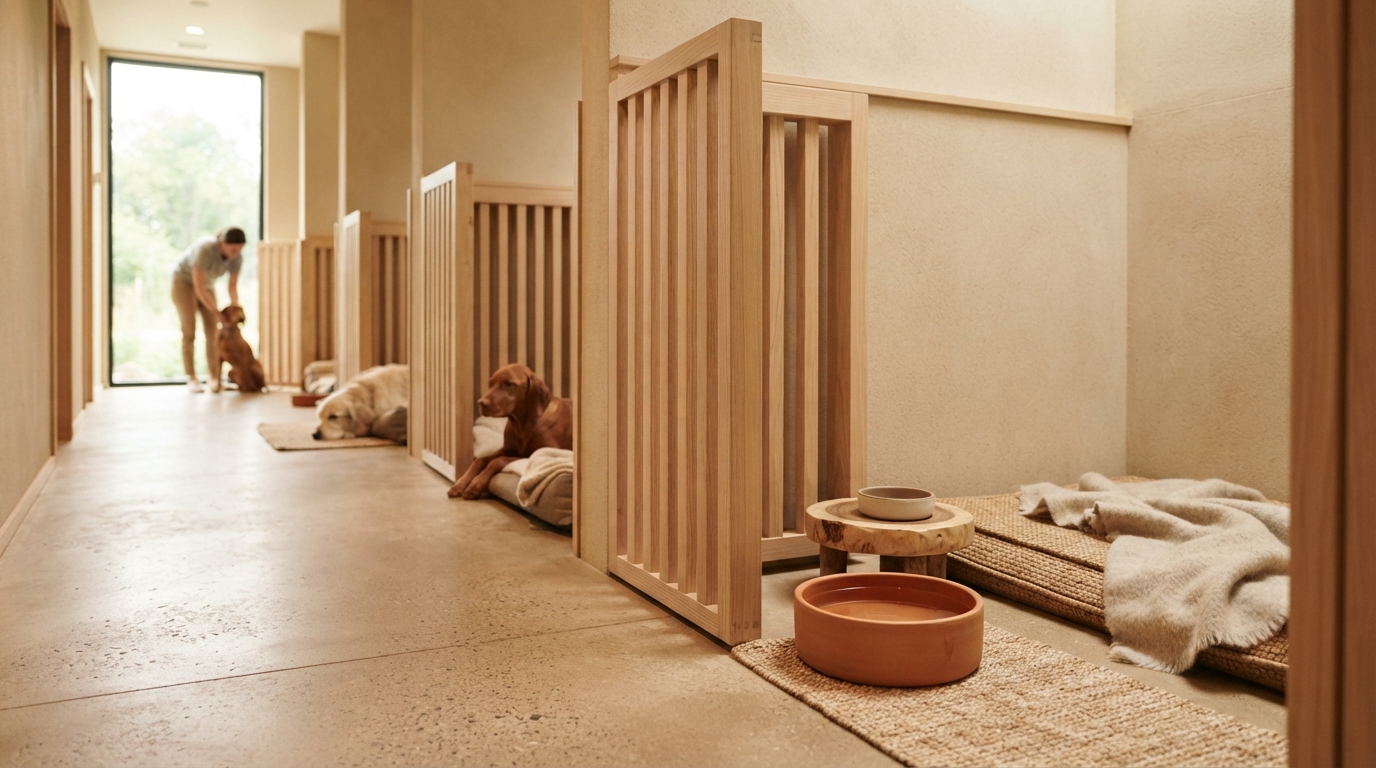
A cat hotel works best when you plan the operation before you think about the front desk or the facade. The customer is not just paying for a place to leave their pet; they are paying for predictability, hygiene, supervision, and clear signs that the cat will stay in an environment suited to its behavior.
It is a business that demands daily attention, has little tolerance for mistakes, and depends heavily on trust. If you get the handling, animal separation, communication with the owner, or cleaning routine wrong, the problem shows up fast and affects the business’s reputation.
- animal lodging
- daily routine
- strict hygiene
- owner trust
What you need to understand before moving forward
Which type of owner do you want to serve?
You need to define whether you will serve frequent travelers, apartment residents, people with a small number of cats, or owners looking for short, recurring stays. That choice changes the booking pattern, the level of demand for photos and updates, and even how you explain safety and adaptation.
Can your space handle proper separation between cats?
Before moving forward, check whether you can maintain distance, visual isolation, and controlled access between animals with different profiles. In a cat hotel, forced coexistence or poorly planned contact creates stress, service refusal, and a higher risk of incidents.
Will you offer basic lodging or additional services?
Decide whether the business will be limited to the stay or whether it will include special feeding, medication, environmental enrichment, and closer monitoring. Every additional service increases operational complexity and requires more routine, more control, and more responsibility.
What health requirements will you enforce at check-in?
You need to define which information and precautions will be mandatory before boarding, such as vaccination history, deworming, feeding habits, and recent signs of illness. This reduces operational risk and makes it clear to the owner what can and cannot enter the hotel.
How will the owner follow the stay?
Define in advance how updates will work, how often they will happen, and who responds when there is a change in behavior. In cat boarding, trust grows when the owner understands what is happening without needing to ask all the time.
The critical points of this business
Market
You need to understand whether there is local demand for cat boarding and whether owners in the area are willing to pay for a more careful service than a generic boarding option. Look at where these customers already search for solutions, which questions they repeat, and which criteria they use to choose.
Offer
The offer needs to be designed around the cat’s behavior, not the operator’s convenience. That includes defining space size, cleaning routine, feeding management, environmental enrichment, and entry rules that prevent incompatible profiles from being mixed.
Operations
Day-to-day work needs to be simple enough to function even during busy periods. You should validate check-in and check-out flow, cleaning between stays, individual tracking for each animal, and responses to signs of stress or refusal to eat.
Location
In a cat hotel, the address needs to make access easier for the owner without exposing the animal to excessive noise, heat, humidity, or traffic that disrupts the routine. The space also needs to allow for the right internal setup, because square footage and layout matter far more than exterior appearance.
Financial
The business depends on consistent occupancy and on a very clear breakdown between revenue per stay, structure costs, and labor costs. You need to know how much each stay must contribute to cover cleaning, food, maintenance, losses, and periods of low occupancy.
Regulation
The activity may require attention to municipal rules, health requirements, and operating conditions compatible with animal welfare. Before investing, check what your city requires to operate an animal boarding business and how that affects structure, licensing, and routine.
What can compromise the business
Mixing cats with incompatible profiles
When the space does not properly separate more reactive, shy, or solitary cats, stress rises and the experience gets worse for everyone. To avoid that, you need intake screening and clear rules about compatibility and adaptation.
Promising care without an operational routine
Nice photos do not sustain a cat hotel if cleaning, feeding, and observation do not follow a defined process. The risk appears when each service depends on someone’s memory instead of a repeatable routine.
Underestimating hygiene work
In cat boarding, cleaning is not a detail; it is part of the offer. If you do not account for time, products, disposal, and cleaning frequency, the operation becomes heavy and quality drops fast.
Accepting animals without enough screening
Receiving cats without checking history, behavior, and health condition increases the chance of conflict, contamination, and stay refusal. A poorly designed intake form costs less than dealing with a problem inside the operation.
Pricing it like regular boarding
If the price does not reflect the level of attention, separation, and routine this service requires, the business starts under pressure. The ideal approach is to validate what the customer sees as value and what your structure can realistically deliver.
Turn these questions into decisions
When you understand the owner profile, the care requirements, and the routine the space must support, the plan stops being a generic idea and becomes a practical decision. That is what organizes the business before the investment, and it is exactly the kind of structure Vibz helps you build.
Business Scope
Use this stage to turn the idea into a clear thesis: what kind of boarding you will offer, for which owner profile, with which care standards, and which assumptions need to be validated before opening.
Market Intelligence
Here you organize your reading of the local market, the profile of the people buying this service, the direct competition, and the entry strategy. This helps answer whether your cat hotel will compete on trust, convenience, specialization, or price.
Operational Plan
This stage helps you design the real operation: entry and exit flow, cleaning routine, animal separation, additional services, team, and suppliers. It is where you check whether the structure can support the level of care the business promises.
Financial Modeling
Use this stage to turn those decisions into numbers for investment, fixed costs, variable costs, working capital, and occupancy scenarios. In a cat hotel, this shows clearly how much the structure needs to bill in order to sustain itself without improvisation.
Before investing, you should know
- How many cats can your space host with proper separation without compromising cleaning and supervision?
- What entry rules will you require to accept an animal, and which cases will you refuse?
- How long does your team take to clean, feed, and monitor each stay at the standard you want to deliver?
- Which additional services make sense in your model, and which ones only add complexity without improving the offer?
- Which type of owner in your region values specialized cat boarding and can understand that difference?
- What initial investment is needed to adapt the space with safety, hygiene, and access control?
- How many stays per month do you need to keep the operation running without depending on improvisation?
Sua ideia merece mais do que um palpite. Estruture o negócio, teste suas premissas e entenda se ele faz sentido antes de comprometer tempo e dinheiro.
Planejar meu negócio no Vibz