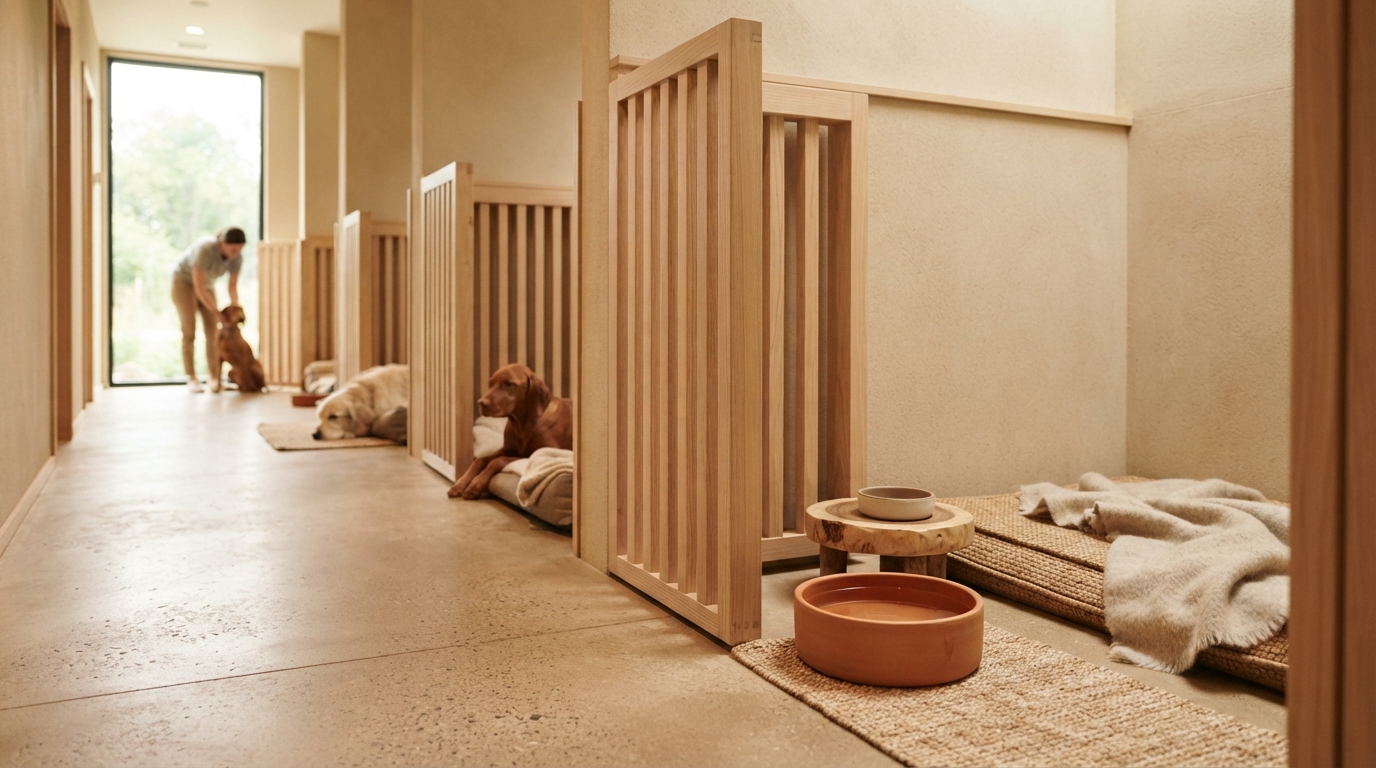
A dog hotel does more than sell a daily rate. You take on feeding, hygiene, supervision, behavior management, and fast response to incidents, which makes the operation more sensitive than many service businesses.
Before investing, you need to know whether your offer makes sense for dogs with the size, profile, and routine your structure can actually support. If the operation is designed for one type of animal and the market asks for another, the business becomes expensive and hard to sustain.
- pet boarding
- daily routine
- physical structure
- trained staff
What you need to understand before moving forward
Profile of the dogs you will serve
You need to define which sizes, ages, and behavioral profiles you will accept. That changes space, handling, area separation, and operational risk.
Real boarding capacity
Capacity should be calculated based on usable area, the split between rest and circulation spaces, and the staff available per shift. Without that, the operation grows on paper and tightens in practice.
Services included in the daily rate
You need to decide whether boarding includes feeding, walks, medication, bathing, enrichment, or updates to the owner. Each addition changes staff time, supply consumption, and service standards.
How clients will come in
Will acceptance be driven by referrals, local search, recurring bookings, or seasonal demand? The answer defines how you fill the calendar and how much you depend on specific times of the year.
Minimum safety conditions
You need to know which rules you will require for vaccination, deworming, behavior, and prior adaptation. In a dog hotel, screening prevents conflict between animals and reduces the chance of problems during the stay.
The critical points of this business
Market
You need to understand who pays for boarding, when demand rises, and what kind of trust this client needs before leaving a dog with you. In this business, the buying decision usually depends less on impulse and more on perceived safety.
Offer
The proposition needs to be clear: basic boarding, boarding with more hands-on care, stays for sociable dogs, or a more selective service. If the offer is too broad, you lose control of the operation and of how you communicate with the owner.
Operations
The daily routine needs to cover intake, animal separation, cleaning, feeding, walks, behavior observation, and checkout. The operation must reduce improvisation, because every failure here affects welfare and reputation.
Location
The property needs to allow safe movement, noise isolation, rest areas, and easy cleaning. The relationship with the neighborhood also matters, because barking, odor, and vehicle traffic can become a problem if the space is not suitable.
People
The team needs to handle animal management, behavior reading, hygiene, and communication with owners. Liking dogs is not enough; consistency is needed to follow protocols and notice signs of stress or conflict.
Regulation
You need to check local requirements, health rules, and property operating conditions before opening. Since the service involves animals under your care, documentary and operational compliance weighs more than in ordinary service businesses.
What can compromise the business
Accepting dogs without proper screening
Mixing incompatible profiles increases the risk of fights, stress, and complaints. To avoid that, define admission criteria, run a prior adaptation process, and record relevant information from the owner.
Underestimating cleaning and odor control
If the hygiene routine is weak, the environment loses quality quickly and the operation becomes hard to sustain. Check materials, drainage, ventilation, and cleaning time before defining the structure.
Promising more care than the team can deliver
Offering more supervision than the staff can actually provide creates oversight failures and client friction. What you promise needs to fit the number of animals, the space, and the work shift.
Choosing a property that does not fit the neighborhood
A space that looks good from the inside may be unworkable because of noise, access, or usage restrictions. Before signing a contract, confirm that the location can handle intake, checkout, and daily stay without conflict with the surroundings.
Operating without clear emergency rules
Without a protocol for escape, injury, food refusal, or contact with the owner, the response becomes slow and unsafe. You need to define in advance who decides, who communicates, and what information is recorded.
Turn these questions into decisions
When you organize this business by stages, it becomes easier to see what is a hypothesis and what is a decision. Vibz helps turn that analysis into a plan, with the right questions before you commit capital.
Business Scope
Start here if you are still defining what kind of dog hotel you want to open, which animals you will accept, and which problem your offer solves best. This stage helps separate idea, audience, and critical bets before you move forward.
Market Intelligence
Use this stage to understand who really looks for boarding, in what situations they buy the service, and how the competition is positioned. It organizes your view of demand, customer profile, and market entry.
Operational Plan
Here you structure the hotel routine: intake, separation, cleaning, feeding, walks, staff, and service channels. This is the stage that turns the offer into daily operation.
Financial Modeling
After deciding on structure and operations, you turn that into investment, costs, expenses, and projected cash flow. This helps you see whether the model fits the capital you have and the occupancy pace you expect to reach.
Before investing, you should know
- How many dogs can you safely board in the space you plan to use?
- Which sizes, ages, and behavioral profiles will you accept?
- Which services will be included in the daily rate and which ones will be charged separately?
- What will the intake, adaptation, and health screening protocol be?
- What physical structure do you need to separate rest, circulation, feeding, and cleaning?
- How many people will be needed per shift to keep the routine running without improvisation?
- Which situations require immediate contact with the owner, and how will that be recorded?
Sua ideia merece mais do que um palpite. Estruture o negócio, teste suas premissas e entenda se ele faz sentido antes de comprometer tempo e dinheiro.
Planejar meu negócio no Vibz