A frozen savory snacks factory requires thinking before buying equipment. You need to decide whether you will produce for direct sales, resale, or supply to other businesses, because each model changes the minimum volume, packaging, logistics, and pressure on production.
What defines the business here is not just the snack recipe. It is the ability to keep standards, maintain proper freezing, turn inventory fast, and run an operation that can handle recurring orders without losing margin.
- batch production
- frozen product
- weight standardization
- refrigerated distribution
What you need to understand before moving forward
Who will you produce for?
You need to separate whether the focus will be end consumers, resellers, snack bars, grocery stores, or events. That changes order size, repeat purchase frequency, packaging requirements, and the kind of negotiation that keeps the factory running.
What mix can the operation handle?
Not every savory snack fits the same production line. You should list the items, check which ones share dough, filling, shaping, and prep time, and cut anything that adds too much complexity at the start.
What minimum volume is worth producing?
The factory needs a volume that justifies ingredient purchases, labor, energy, losses, and freezing. Without that calculation, you may sell a lot and still operate on a tight margin.
How will the product reach the customer?
You need to decide whether delivery will be in-house, pickup-based, through distributors, or via local partners. With frozen products, logistics is not a detail: it affects shelf life, product integrity, and cost per order.
What needs to be standardized before selling?
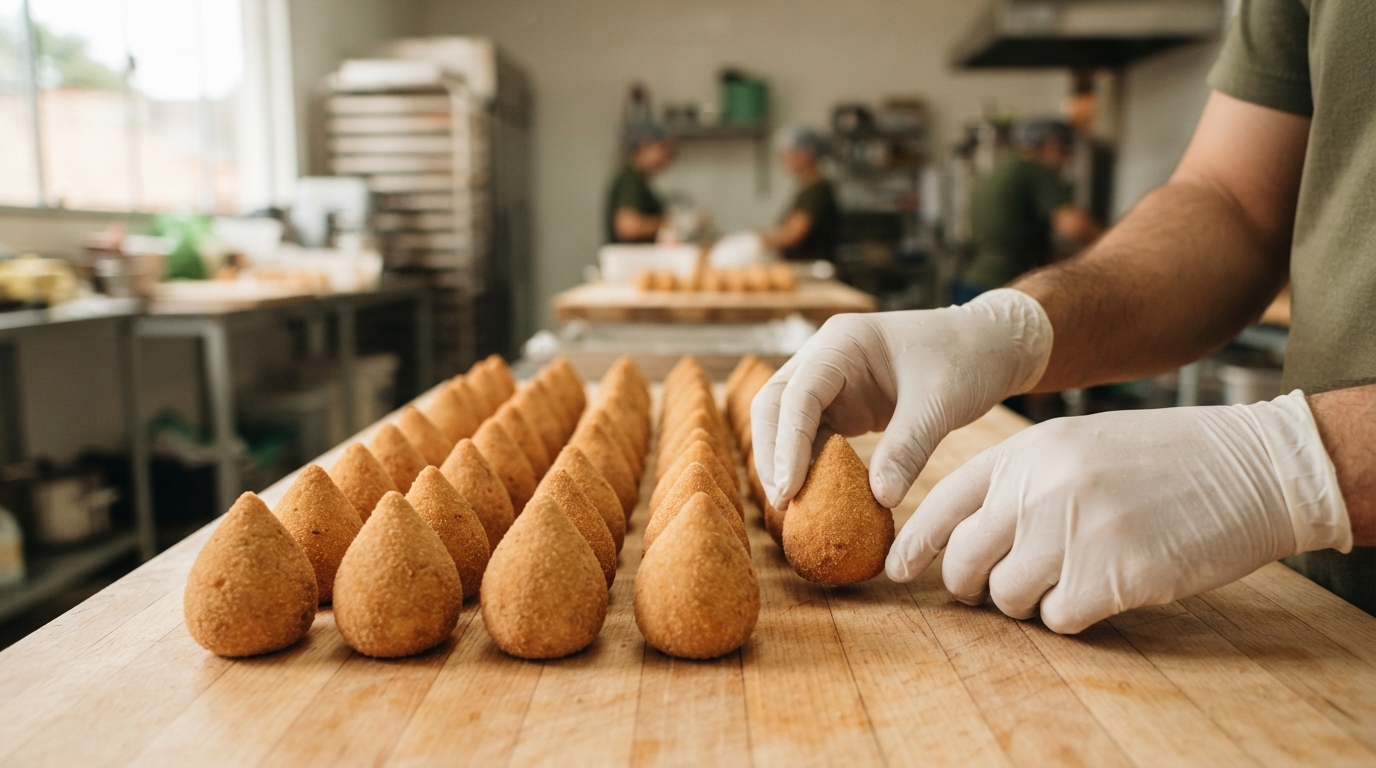
Weight, size, filling, packaging, and baking or frying time need to be defined. If each batch comes out differently, customers notice, waste rises, and repeat purchases become harder.
The critical points of this business
Offer
You need to start with a small number of items and validate whether they sell enough to support production. In frozen savory snacks, too much variety usually gets in the way more than it helps.
Operations
The routine needs to cover prep, shaping, freezing, storage, and shipping without bottlenecks between stages. The operation design should consider space, workflow, and the ability to keep the product in the right condition until it leaves.
Financials
The numbers have to separate the cost of dough, filling, packaging, losses, energy, labor, and distribution. If you do not measure unit cost and the impact of ice, leftovers, and returns, the margin becomes misleading.
Regulation
Producing food requires attention to health regulations, proper structure, and documentation that fits the type of operation. Before investing, it is worth understanding what your city requires to manufacture, store, and transport frozen products.
Channels
The factory needs to be built with an outlet for the product already in mind. Made-to-order sales, resale, and recurring supply all require different production and billing rhythms.
People
Quality depends on people who follow standards for weight, filling, hygiene, and packaging. If the operation relies on improvisation, the product loses consistency and the factory becomes hard to scale.
What can compromise the business
A mix larger than the operation can support
Trying to launch with too many flavors usually increases waste, inventory confusion, and production delays. The better path is to start with a short line and see which items really move.
Pricing set without unit cost
If you price only by looking at the market, you may sell without covering packaging, losses, freezing, and delivery. The calculation needs to start from the real cost of each snack, batch, and channel.
Insufficient storage
Frozen products require space and control to protect quality and shelf life. If inventory grows without structure, the operation loses standards and the risk of disposal increases.
Dependence on occasional sales
Producing only when an order appears is risky for a factory because it makes it hard to plan purchasing and labor. The business improves when there is at least some predictability in demand.
Weak standardization across batches
If each tray or batch comes out with different weight and filling, customers notice and repeat purchases drop. Before scaling, you need to test the process, technical sheet, and quality control.
Turn these questions into decisions
When you understand the market and organize the operation before investing, the factory stops being a vague bet and becomes a business thesis. That is the point where the plan needs to be structured around the decisions that actually change the result.
Business Scope
Helps you define the factory model, the target audience, the value proposition, and the assumptions that need to be validated before buying equipment.
Market Intelligence
Organizes your view of demand, competition, buying behavior, and entry strategy, so you can decide whether the volume and channel make sense for frozen savory snacks.
Operational Plan
Maps how production will work in practice, from choosing the items to the flow of prep, freezing, storage, team, and sales channels.
Financial Modeling
Turns those decisions into investment numbers, unit cost, working capital, and cash flow to test whether the factory adds up before you buy.
Before investing, you should know
- How many snacks do you need to sell per month to cover production, storage, delivery, and overhead?
- Which menu items share the same production base, and which require different processes?
- How much does each unit cost, including dough, filling, packaging, losses, and distribution?
- What is the real freezing and storage capacity before the product starts losing quality?
- Will you sell to end consumers, resellers, or recurring buyers, and which channel can move volume faster?
- What sanitary and structural requirements do you need to meet before starting production?
- What minimum order volume allows you to buy ingredients and organize production without improvisation?
Sua ideia merece mais do que um palpite. Estruture o negócio, teste suas premissas e entenda se ele faz sentido antes de comprometer tempo e dinheiro.
Planejar meu negócio no Vibz