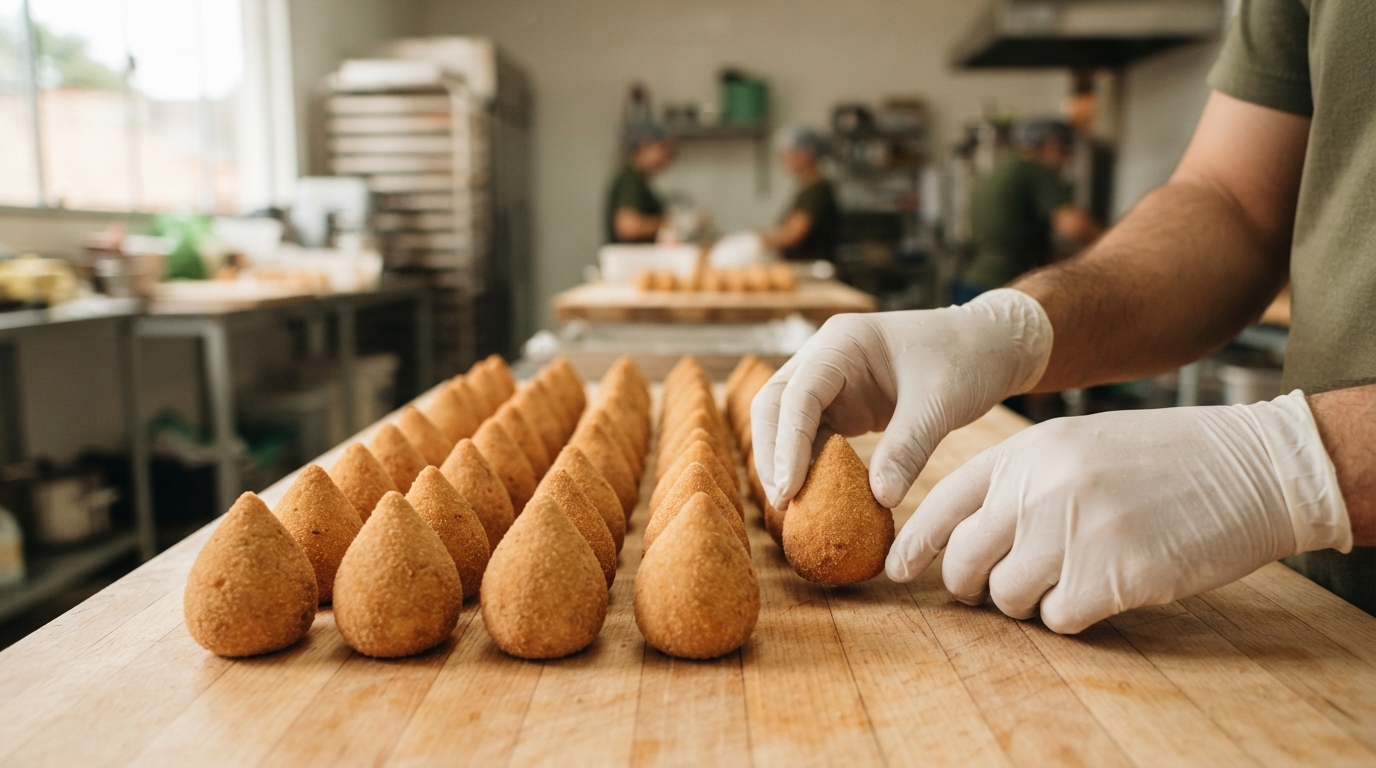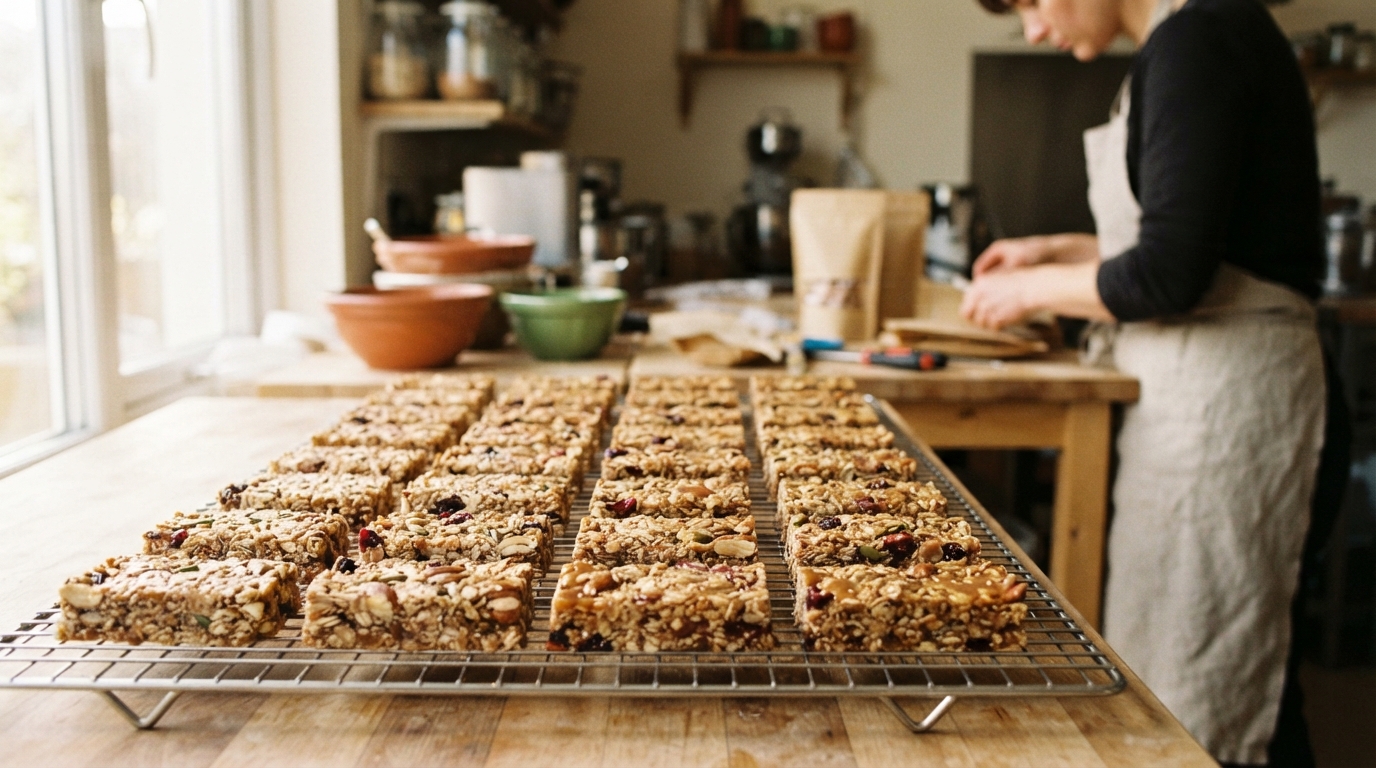
This kind of factory requires more planning than many ready-to-eat food businesses, because you are working with packaged products, defined shelf life, and a need for consistency from batch to batch. Small issues in texture, weight, labeling, or storage affect repeat purchases and can block entry into more demanding channels.
Before investing, you need to know whether you will work with your own recipe, outsourced production, or a lean industrial setup. The answer changes your initial investment, regulatory complexity, need for technical staff, and the pace at which you can test the market.
- packaged product
- short shelf life
- standardized batch
- retail channel
What you need to understand before moving forward
Your own recipe or outsourcing?
You need to decide whether you will start with your own formulation and manufacturing or outsource part of production. That defines how much you invest before validating product acceptance and how much of the operation stays under your control.
Which channel will buy first?
Direct sales, specialty stores, gyms, gourmet shops, marketplaces, or retail distribution do not require the same structure. The chosen channel changes packaging, minimum order size, payment terms, and restocking frequency.
Does the shelf life support the operation?
The product’s shelf life needs to fit stock levels, distribution, and channel turnover. If it is too short for your logistics, you increase loss, returns, and pressure on production and sales.
Can the formulation scale?
A recipe that works in small production can change in texture, moisture, or consistency when volume grows. You need to test whether the process remains stable at a larger batch size before taking on contracts or expanding the setup.
Does the packaging protect and sell?
Packaging has to preserve the product and communicate what the buyer expects to find. In healthy snacks, that matters because the customer compares appearance, nutritional promise, and convenience in the same buying moment.
The critical points of this business
Market
You need to understand who buys for health, who buys for convenience, and who buys for a specific diet. These audiences may look similar, but they buy for different reasons and require different messages, formats, and channels.
Offer
The product needs a clear position between indulgence, functionality, and price. If the proposition stays generic, you end up in direct competition with many similar options and lose strength on the shelf.
Operations
The factory depends on control of weighing, mix consistency, cutting, packaging, and batch traceability. In ready-to-eat food, operations cannot vary too much from one day to the next, because that affects standard, safety, and complaints.
Financials
You need to model raw material cost, production waste, packaging, freight, channel commission, and payment terms. In packaged food businesses, apparent margin without considering returns and trade discounts is usually misleading.
Regulation
The business requires attention to sanitary rules, labeling, and responsibility for nutritional and allergen information. This has to be correct from the start, because fixing it later usually costs more than setting it up properly.
Channels
The channel defines order size, registration requirements, commercial negotiation, and turnover speed. For this business, selling well is not just about winning orders; it is about restocking regularly without losing consistency.
What can compromise the business
Starting with a mix that is too broad may seem strategic, but it usually slows the factory down early. Each additional flavor or format increases ingredient purchases, inventory control, shelf-life testing, and the chance of stockouts.
Choosing ingredients for their perceived appeal rather than how they behave in production creates an unstable product. Some formulations look good in testing, but break, crumble, or lose texture after storage and transport.
Ignoring channel requirements usually makes market entry more expensive. If the packaging, label, order volume, or delivery time do not match the buyer’s expectations, the deal dies before the repeat order.
Underestimating production losses distorts the entire business case. In packaged food, leftover raw material, batches out of spec, and products close to expiration affect margin directly.
Setting up the operation without batch-level control makes it harder to fix problems. When a complaint appears, you need to know what was produced, with which inputs, and where it was shipped.
Turn these questions into decisions
When you understand who buys, how the product leaves the factory, and which channel brings it to market, the decision stops being generic. Vibz helps organize these choices before you commit capital to structure, inventory, and packaging.
Business Scope
Use this stage to turn the idea into a testable thesis: what kind of bar or snack you will sell, to whom, with what proposition, and which assumptions need to be tested before buying equipment.
Market Intelligence
Here you structure the analysis of who buys, which channels make sense, and how the competitive environment affects entry. That helps you decide whether it is better to start with direct sales, specialty retail, or distribution.
Operational Plan
This stage organizes the operation before the first major purchase: processes, suppliers, team, packaging, and channels. For a snack factory, it helps design the flow that supports consistency, shelf life, and traceability.
Financial Modeling
Here you turn those decisions into investment, cost, working capital, and cash flow numbers. It is the stage that shows whether the model holds when you consider losses, lead times, and real production scale.
Before investing, you should know
- What will be the first product, and how many variations do you really need to launch at the beginning?
- Which sales channel can your current or planned structure actually serve?
- What shelf life does the product need to fit your logistics and turnover?
- What minimum batch size makes sense for your production without creating excess leftover stock?
- How much does each unit really cost once you include raw materials, packaging, waste, and freight?
- Which sanitary and labeling requirements do you need to meet before selling the first batch?
- What level of consistency can you maintain from batch to batch without relying on improvised adjustments?
Sua ideia merece mais do que um palpite. Estruture o negócio, teste suas premissas e entenda se ele faz sentido antes de comprometer tempo e dinheiro.
Planejar meu negócio no Vibz